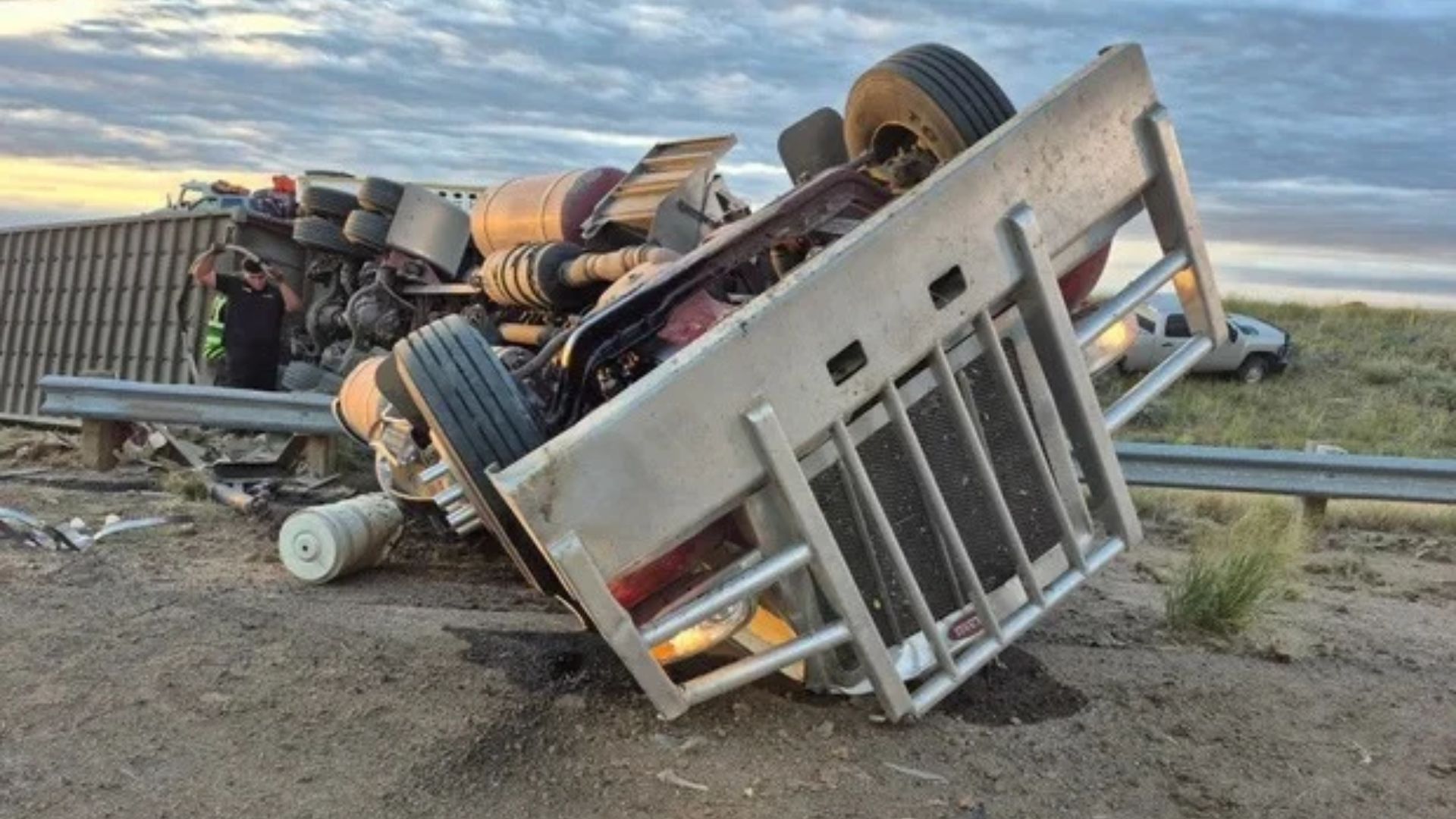
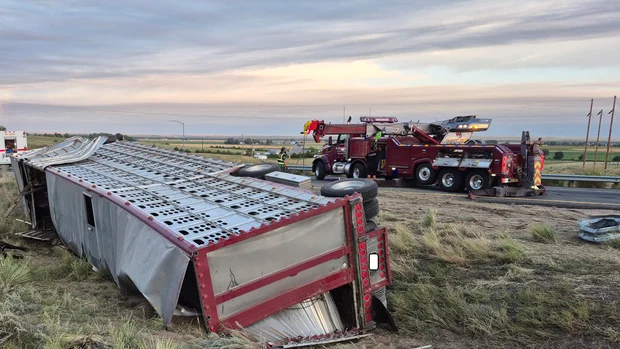
Just before 3 a.m. on Tuesday, September 15, 2026, a semi hauling 48 cattle traveled westbound on Interstate 76. It was east of Brush when it entered the center median and rolled over. The trailer’s cargo spilled across the highway.
Three additional semis and a passenger vehicle then struck cattle that were in the roadway.
The livestock trailer driver was taken to the hospital by ambulance. The extent of the driver’s injuries is unknown. Of the 48 cattle on board, 10 were found dead, 29 were found alive, and nine remain unaccounted for as of Tuesday morning.
The investigation is ongoing. Colorado State Patrol has not shared more details.
It is still unclear what caused the cattle trailer to enter the median.
The trailer rolled over.
This crash is unusual — and legally more complicated than it first appears. The people who need to understand what happened are the drivers of the three other semis and the passenger vehicle that struck cattle on the roadway.
They did not cause the initial crash. They were driving legally on an open interstate. And they now face vehicle damage, possible injuries, and questions about who caused the chain reaction.
Two Separate Incidents: The Rollover and the Secondary Strikes
What happened on I-76 this morning involves two distinct events that need to be analyzed separately.
The first is the rollover itself. A livestock transport semi entered the median and lost control early in the morning. The cause of that initial loss of control is the central question investigators will pursue. Fatigue, speed, mechanical failure, and driver error are all possibilities on a long overnight haul on a dark eastern plains highway.
The second is the chain reaction — three semis and a passenger vehicle striking cattle that had spilled onto the interstate in the dark. Those drivers could not reasonably see and avoid livestock on an interstate highway at night. They were struck by the consequences of someone else’s crash.
The liability analysis for the secondary drivers does not turn on what caused the initial rollover. It turns on whether the livestock trailer operator’s negligence — whatever form that took — was the proximate cause of the hazard those drivers encountered.
Source: Colorado State Patrol
The Livestock Trailer Driver’s Duty of Care
Any driver operating a vehicle on a Colorado highway has a duty to exercise reasonable care. Under C.R.S. Section 42-4-1402, careless driving is defined as operating a vehicle in a careless and imprudent manner without due regard for the width, grade, curves, corners, and traffic on the highway and all other attendant circumstances. A livestock trailer entering the center median and rolling over in the early morning hours raises an immediate question about whether that standard of care was met.
The investigation will examine what caused the semi to leave the westbound travel lanes. Possible causes include:
• Driver fatigue or microsleep on an overnight haul across the eastern plains
• Speed inappropriate for the road, lighting, or load being carried
• Mechanical failure of the trailer’s brakes, tires, or coupling
• Improper load distribution or inadequate securing of the livestock, which can cause shifts in the trailer’s center of gravity
• Distraction or impairment
Each of these carries different legal implications. But for the drivers who were struck by cattle in the roadway, the specific cause of the rollover is almost secondary to the fact that it happened and that the resulting hazard was foreseeable — anyone transporting a heavy livestock load on a highway at night should understand that a rollover creates exactly this kind of danger.
Commercial Carrier Liability: Beyond the Driver
This was a commercial livestock transport. That means the driver alone is not the only party who bears potential responsibility.
The motor carrier — the company that owns or operates the semi and trailer — carries independent duties under federal and Colorado law to maintain the vehicle in safe operating condition, ensure the driver is properly qualified and not fatigued, and manage the load safely. If CSP’s investigation reveals that the driver was operating on too few hours of rest, that the trailer had maintenance deficiencies, or that the load was improperly secured, the carrier faces direct liability alongside the driver.
The livestock owner — if different from the carrier — may also have obligations regarding how the animals were loaded and secured. A load of 48 cattle that spills across an interstate highway is not a contained incident. It is a foreseeable consequence of a rollover, and the question of whether adequate precautions were taken to minimize that consequence is worth examining.
What Colorado Law Says About Livestock on Roadways
Colorado has specific law addressing livestock on public roads. Under C.R.S. Section 35-46-105, it is unlawful for the owner or person in charge of livestock to knowingly allow them to graze or run loose on a public highway. While this statute primarily addresses uncontrolled livestock, its application to situations where livestock spill from a carrier is a question investigators and attorneys will consider.
The broader framework of Colorado’s open range doctrine and livestock liability is a nuanced area of law. We covered it in detail in our earlier post, Car Accidents Caused by Livestock: Who Is Liable? — which is worth reading for anyone affected by this type of crash. The key takeaway here is that open range protections generally apply to livestock owners whose animals wander onto roads from unfenced land, not to carriers whose vehicles roll over and spill cargo across an active interstate.
The Drivers Who Struck Cattle: Their Legal Position
The three semi drivers and the passenger vehicle driver who struck cattle are the most straightforward victims in this scenario. They were operating legally on an open interstate. Under C.R.S. Section 13-21-111, Colorado’s comparative negligence framework, their fault in this crash is likely zero or minimal. The hazard they encountered — cattle in the roadway at 3 a.m. on I-76 — was created by someone else’s loss of control.
Their recoverable damages may include vehicle damage and repair costs, lost income if their own commercial vehicles are out of service, physical injuries if any were sustained in the collisions, and any cargo losses if their loads were affected.
For the passenger vehicle driver in particular — a private individual rather than a commercial operator — the crash carries additional weight. Striking a large animal at highway speed in the dark can cause serious injury. The passenger vehicle’s damage and any occupant injuries deserve prompt investigation and documentation.
Evidence That Must Be Preserved Now
The scene has been cleared and I-76 has reopened. But critical evidence still exists and needs to be preserved quickly.
• The livestock trailer itself, which CSP likely has secured at the scene or tow yard — its mechanical condition, tire condition, brake function, and cargo restraint system are essential evidence
• Electronic logging device data from the semi, which captures the driver’s hours of service in the days and hours before the crash
• Event data recorder information from the semi, capturing speed, braking, and steering inputs before the rollover
• CSP’s crash reconstruction findings and any measurements or photographs taken at the scene before the road reopened
• Dashcam footage from any of the four vehicles that struck cattle, if any were equipped with cameras
• CDOT traffic camera footage from the I-76 corridor near mile marker 102
• Medical records for the livestock trailer driver documenting the nature and extent of injuries, which may also shed light on the driver’s condition at the time of the crash
• The carrier’s maintenance records, inspection logs, and hours-of-service records for the driver
A Note on This Ongoing Investigation
Colorado State Patrol is actively investigating. The cause of the initial rollover has not been determined. No charges have been filed. This blog does not speculate about specific fault determinations.
What the documented facts establish is that a commercial vehicle rollover placed livestock on an active interstate in the dark, resulting in four additional vehicle collisions. The drivers and occupants of those vehicles deserve a thorough understanding of who bears responsibility for what happened on I-76 this morning.
If You Were Involved in This Crash
Bowman Law handles serious trucking accident cases and motor vehicle accident cases throughout Colorado, including crashes involving commercial carriers and multi-vehicle chain reactions. If you were in one of the vehicles that struck cattle on I-76 this morning, or if you were the livestock trailer driver, we are available for a confidential conversation at no charge and no obligation.
Jerry Bowman, J.D., M.A., Owner and managing attorney of Bowman Law LLC, takes his responsibility to the legal profession seriously and dedicates his time and effort to providing quality and competent legal representation to clients in Denver and throughout all of Colorado. He holds an MA in Political Science from Wayne State University and earned his law degree in two and a half years from Michigan State University College of Law.
When an NFL linebacker delivers a helmet-to-helmet hit, the collision lasts milliseconds and the forces involved are, by physics standards, moderate. The NFL spent nearly a billion dollars settling concussion ...
A unanimous decision by the United States Supreme Court in Montgomery v. Caribe Transport II, LLC, on May 14, 2026, held that plaintiffs in truck crash cases can hold brokers ...
A recent 60 Minutes investigation drew attention to a dangerous practice affecting more than one in five trucking companies in the United States. The investigation focused on so-called “chameleon carriers,” ...


 Return to All News & Resources