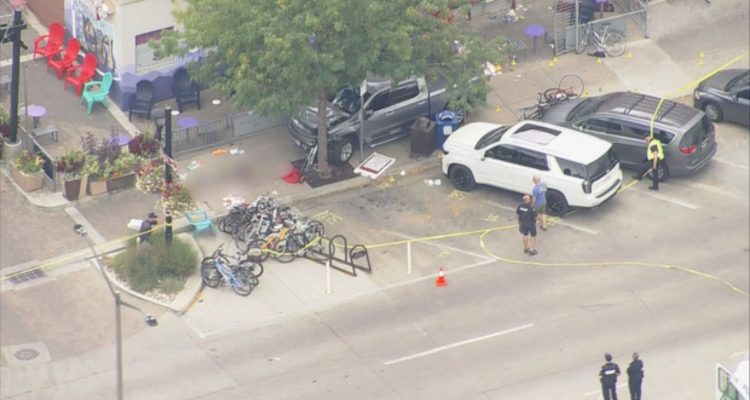
Around 5 a.m. on Saturday, July 26, 2026, a vehicle stalled on Interstate 25 near the Auraria Parkway interchange in Denver. The driver or a passenger got out of the disabled vehicle. Standing on an active interstate in the dark, they were struck by oncoming traffic. They died at the scene. Multiple other people suffered serious injuries in the same crash. Denver Police closed northbound lanes while officers investigated. (Denver7, July 26, 2026; CBS Colorado, July 26, 2026)
The identity of the person who was killed has not been released. The number of vehicles involved has not been confirmed. The investigation is ongoing.
What happened on I-25 near Auraria Parkway Saturday morning is one of the most dangerous situations any driver or passenger can find themselves in: a disabled vehicle on a high-speed urban interstate, in the dark, with traffic approaching at highway speeds. It raises serious legal questions about who bears responsibility when a breakdown becomes a fatality.
When a Stalled Vehicle on an Interstate Leads to a Death
Breakdowns happen. Vehicles lose power, blow tires, and run out of fuel on Colorado highways every day. What happens after the breakdown — where the vehicle stops, whether it is visible to approaching drivers, and whether the people inside stay in the vehicle or get out — often determines whether a situation is merely stressful or fatally dangerous.
The most important safety principle for anyone in a disabled vehicle on a highway is to stay inside with seatbelts on, if possible, and call for help. A person standing on an active interstate lane or shoulder is vastly more vulnerable than a person inside a vehicle. The metal structure of even a disabled car provides meaningful protection. A person on foot has none.
That principle, however, does not resolve the legal questions that arise when a person is killed after exiting a stalled vehicle. The circumstances that led to that decision — whether the vehicle was in a lane, whether it was on fire or otherwise undrivable, whether the person was attempting to reach safety — all factor into the analysis of what happened and who bears responsibility for it.
Colorado Law and the Duty to Other Drivers
Under C.R.S. Section 42-4-202, no person may operate a vehicle on a Colorado highway in a condition that endangers other people on the road. When a vehicle becomes disabled and stops in a travel lane, the driver has specific obligations — to move the vehicle to the shoulder if at all possible, to activate hazard lights, and to take steps to warn approaching traffic.
Colorado’s move-over and disabled vehicle law under C.R.S. Section 42-4-705 also imposes duties on approaching drivers. When a disabled vehicle is present on or near a roadway with lights activated, other drivers must move over a lane when safely possible, or reduce speed and proceed with caution. On a highway like I-25 near Auraria Parkway, at 5 a.m., that duty was in effect for every vehicle approaching the scene.
Whether the drivers who struck the victim complied with that duty is a central question in any civil investigation of this crash. Speed, lane position, and whether any of the approaching drivers had adequate warning of the disabled vehicle and the person standing near it will all be examined.
Multiple Potential Liable Parties
Crashes involving stalled vehicles and multiple injured parties rarely trace back to a single responsible party. In a case like this one, the investigation may look at several directions.
The driver of the stalled vehicle had an obligation to position the vehicle as safely as possible and to warn approaching traffic. If the vehicle stopped in a travel lane rather than reaching the shoulder, that positioning contributed to the danger. If hazard lights were not activated, or if no other warning was given to approaching traffic, that failure matters.
The drivers who struck the victim had an obligation to observe hazards ahead and respond appropriately. At 5 a.m. on an urban interstate, maintaining attentiveness and appropriate speed is a baseline legal duty. If any of the approaching drivers were speeding, distracted, or impaired, that conduct directly contributed to the fatality.
If the vehicle stalled due to a mechanical defect — a sudden, unforeseeable failure rather than a maintenance issue the driver knew about — a product liability claim against the vehicle manufacturer may also be worth examining. Sudden unintended acceleration, electronic failures, or powertrain defects that cause a vehicle to lose control or stall unexpectedly have been the subject of significant litigation against automakers.
The road itself is also a factor worth examining. Near the Auraria Parkway interchange, I-25 has specific lane configurations, lighting levels, and shoulder conditions. If inadequate lighting, poor shoulder design, or insufficient emergency pull-off access contributed to why a disabled vehicle ended up in or near a travel lane, CDOT’s design and maintenance standards become relevant.
Identifying all potentially liable parties requires a thorough investigation — and that investigation needs to begin while the scene evidence still exists.
The Person Who Was Killed: Wrongful Death Rights for the Family
For the family of the person who died on I-25 near Auraria Parkway Saturday morning, Colorado’s wrongful death statute, C.R.S. Section 13-21-202, provides the right to seek compensation when a death results from the wrongful act, neglect, or default of another. That right does not require a prior criminal charge or conviction — it requires proof that another party’s conduct caused the death.
Under C.R.S. Section 13-21-203, recoverable damages in a wrongful death claim include economic losses — the income and financial support the deceased would have provided — and noneconomic damages including grief, loss of companionship, pain and suffering, and emotional stress experienced by surviving family members.
Even in cases where the person who died may bear some portion of fault — for having exited the vehicle, for standing in a dangerous position — Colorado’s comparative negligence framework does not automatically bar the family’s claim. As long as the deceased’s share of fault does not exceed 50 percent, the family can still recover, reduced proportionally by that share.
The circumstances of why that person exited the vehicle matter enormously. Someone who stepped out to check a flat tire in the dark is in a very different legal position than someone who exited voluntarily and walked into traffic. The investigation will address this.
The People Who Were Seriously Injured
Denver Police confirmed that multiple people suffered serious injuries in this crash. Those individuals — whether they were occupants of the stalled vehicle, drivers or passengers in other vehicles, or others involved — each have independent rights to pursue compensation for their injuries.
Under C.R.S. Section 13-21-111, fault is apportioned among all contributing parties. A person who was injured through no fault of their own — an occupant of a passing vehicle that was forced into a secondary collision, for example — carries no fault and their claim is not subject to reduction. Each injured person’s situation requires its own analysis.
Serious injuries on an interstate often include traumatic brain injury, spinal damage, internal trauma, and significant orthopedic injuries. These have long-term consequences that extend well beyond initial hospitalization. A civil claim that accounts only for emergency room costs dramatically undervalues what a seriously injured person has lost.
Evidence That Is Available Now and Will Not Last
I-25 near Auraria Parkway is one of the most monitored stretches of urban interstate in Denver. CDOT maintains a dense network of traffic cameras along this corridor, and footage from those cameras may capture the moments before, during, and after the crash. That footage operates on retention schedules — without a preservation demand, it may be overwritten.
Other critical evidence includes:
• Dashcam footage from any of the vehicles involved or from other drivers who passed through the scene
• Event data recorder information from each vehicle, capturing speed, braking, and steering inputs in the seconds before impact
• Cell phone records for any driver whose distraction may have played a role
• The physical condition of the stalled vehicle, including whether hazard lights were functional and activated
• Toxicology results for any driver where impairment is a question
• The condition of the roadway, lighting infrastructure, and shoulder at the specific location
• Witness accounts from other motorists who passed or stopped near the scene
Denver Police are conducting the investigation. Their process answers to the criminal and administrative standard. A civil investigation conducted on behalf of the injured and the family of the deceased answers to their interests — and preserving the evidence needed for that investigation requires acting now.
A Note on This Ongoing Investigation
Denver Police have not released the identity of the person who died, the number of vehicles involved, or additional details about the circumstances of the crash. This blog does not speculate about specific fault determinations. The investigation is active and the full picture of what occurred on I-25 near Auraria Parkway Saturday morning is still being assembled.
What the confirmed facts establish is that a person exited a stalled vehicle on an active interstate in the dark and was struck and killed by oncoming traffic. Multiple others were seriously injured. Every party whose conduct contributed to that outcome bears legal scrutiny — and the families and survivors deserve answers.
If you or a family member was involved in the July 26 crash on I-25 near Auraria Parkway, or if you lost someone in this incident, the time to act is now. Evidence is being gathered. Insurance companies are already involved. Your rights deserve the same attention.
Call us at 720-863-6904 or visit coloradopersonalinjuryhelp.com for a free and confidential consultation. There is no charge and no obligation.problem. And a maintenance problem that kills or seriously injures innocent people on a Colorado highway is a liability problem — one that the driver and anyone else responsible for that vehicle’s condition may have to answer for.
Jerry Bowman
Owner and Managing Attorney
Jerry Bowman, J.D., M.A., Owner and managing attorney of Bowman Law LLC, takes his responsibility to the legal profession seriously and dedicates his time and effort to providing quality and competent legal representation to clients in Denver and throughout all of Colorado. He holds an MA in Political Science from Wayne State University and earned his law degree in two and a half years from Michigan State University College of Law.
At 8:15 p.m. on Friday, September 26, 2026, Aurora Police responded to a vehicle versus pedestrian crash near the intersection of South Peoria Street and East Tennessee Avenue. A 35-year-old ...
Around 9:15 p.m. on Monday, September 1, 2026, two men were crossing southbound Highway 287 on foot near West 66th Avenue in the Berkley area of Adams County when a ...
Source: CBS UPDATE — September 4, 2026 The Larimer County Coroner’s Office has identified the man killed in the August 29 Tour de Fat crash as Joshua Robert Douglass, 33, ...


 Return to All News & Resources