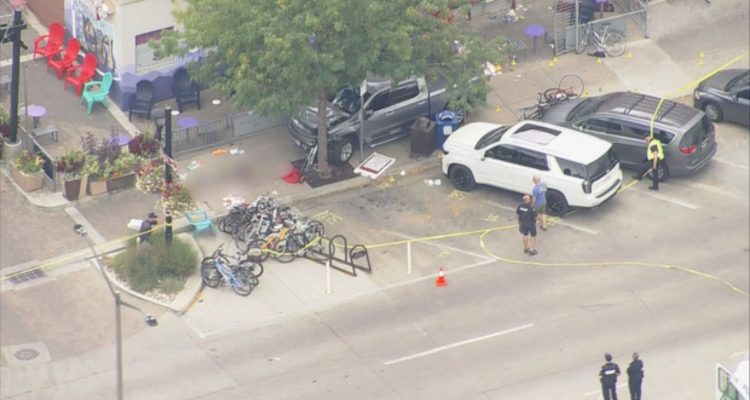
Around 9:15 p.m. on Monday, September 1, 2026, two men were crossing southbound Highway 287 on foot near West 66th Avenue in the Berkley area of Adams County when a white Ford F-150 struck both of them and drove away. A 38-year-old man was pronounced dead at the scene. A 46-year-old man was taken to a hospital with serious injuries.
Colorado State Patrol located the abandoned F-150 near Decatur Street just south of West 67th Place, with damage consistent with the crash. A person of interest has been identified.
CSP is working to locate that person. No information about the person of interest has been released. (Denver7, September 1, 2026)
CSP initially reported the victims were on a motorcycle before clarifying that no motorcycle or second vehicle was involved. Both men were on foot crossing the highway when the truck struck them.
A person is dead. Another is seriously injured.
The driver fled. A person of interest has been identified but not yet located. For the families of both victims, the legal question is the same one that arises in every hit-and-run: what can be done before a formal arrest is made?
The answer is more than most people expect.
The Civil Case Does Not Wait for an Arrest
In Colorado, a civil personal injury or wrongful death claim runs on an entirely separate track from the criminal investigation. A criminal arrest, charge, or conviction is not required before a family can take legal action. The civil standard of proof — more likely than not — is different from the criminal standard, and the civil process operates on its own timeline.
That independence matters practically. It means the family of the man who was killed, and the man who was seriously injured, can begin a civil investigation immediately — gathering evidence, issuing preservation demands, and building the factual record — without waiting for CSP to locate and charge the person of interest.
It also means that if the person of interest is never charged, or charges are eventually dropped, the civil case can still proceed. A criminal acquittal does not bar a civil claim. A failure to prosecute does not bar a civil claim. The two systems answer to different standards and different burdens.
Hit-and-Run: What Colorado Law Requires and What It Means Civilly
Under C.R.S. Section 42-4-1601, a driver involved in a crash resulting in injury or death has a legal duty to immediately stop, remain at the scene, provide their information, and render reasonable assistance. Leaving the scene of a crash that killed someone is a class 3 felony in Colorado. Leaving the scene of a crash that caused serious bodily injury is a class 4 felony.
The hit-and-run has civil significance beyond the criminal charge. A driver who strikes two pedestrians and flees without stopping has committed two distinct wrongs: the crash itself, and the deliberate decision to abandon the victims. That decision is not merely a traffic violation. It is a conscious act that deprived the victims of immediate medical assistance and deprived investigators of real-time evidence.
In a civil case, the hit-and-run itself is evidence of the driver’s state of mind — awareness of guilt, consciousness of wrongdoing, and deliberate disregard for the harm caused. Those facts bear on both the liability analysis and the potential for exemplary damages if the case supports them.
The Duty Drivers Owe Pedestrians Crossing a Highway
Colorado law places an affirmative duty on all drivers to exercise reasonable care to avoid colliding with pedestrians. Under C.R.S. Section 42-4-703, a driver must exercise due care to avoid colliding with any pedestrian on or near a roadway. On Highway 287 at night, where pedestrians may be crossing, that duty includes maintaining appropriate speed, staying alert, and responding to conditions on the road.
The fact that two men were crossing a state highway on foot raises its own questions about the pedestrian crossing location, available crosswalks, lighting, and visibility. Those facts will factor into the comparative fault analysis. But the duty of care does not disappear because pedestrians are crossing at a location other than a marked crosswalk — and the driver’s decision to flee shifts the moral and legal weight heavily against the at-fault driver.
Insurance When the Driver Has Not Been Identified
This is the question that families of hit-and-run victims ask most urgently: if the driver has not been caught, is there any coverage available now?
Yes. Colorado law requires all auto insurance policies to include uninsured motorist coverage, which applies specifically in hit-and-run situations.
Under C.R.S. Section 10-4-609, uninsured motorist coverage — commonly called UM coverage — must be offered with every auto insurance policy in Colorado. UM coverage applies when an at-fault driver is uninsured or, in a hit-and-run, when the at-fault driver cannot be identified. If either victim or a resident relative in their household carried auto insurance, that policy’s UM coverage is available right now, regardless of whether the hit-and-run driver has been found.
The injured man’s own insurance is the first place to look. The family of the man who was killed should examine his insurance as well as any coverage held by resident relatives in his household. UM coverage can provide compensation for medical bills, lost wages, pain and suffering, and in a wrongful death claim, the full range of damages the family has suffered — without waiting for the investigation to conclude.
If the person of interest is ultimately identified and located, additional coverage through the driver’s own liability insurance becomes available on top of any UM recovery already pursued.
Wrongful Death Rights for the Family of the Man Who Was Killed
For the family of the 38-year-old man who was killed, Colorado’s wrongful death statute, C.R.S. Section 13-21-202, provides the right to seek compensation for the full scope of losses his death caused. Those losses include medical and emergency response costs before death, funeral and burial expenses, the income and financial support he would have provided, and the grief, loss of companionship, pain and suffering, and emotional stress his family now carries.
Recoverable damages under C.R.S. Section 13-21-203 include both economic and noneconomic losses. The two-year statute of limitations for wrongful death under C.R.S. Section 13-80-102 runs from the date of death. Acting early protects the evidence and the claim.
Rights of the Seriously Injured Survivor
The 46-year-old man who survived with serious injuries has his own independent claim. Under C.R.S. Section 13-21-111, Colorado’s comparative negligence framework, the fault analysis will examine both drivers’ and pedestrians’ conduct. The two men were crossing a state highway on foot — how and where they were crossing will be part of the analysis. But the driver’s flight from the scene eliminates any argument that the driver acted with care or concern for the victims’ safety, and that weighs heavily in the legal picture.
Serious injuries from a vehicle strike can include traumatic brain injury, spinal damage, broken bones, internal trauma, and significant soft tissue injuries. The survivor’s damages may be substantial, and UM coverage under his own or a resident relative’s policy is available to him now regardless of whether the driver has been identified.
Evidence That Must Be Preserved Right Now
The most valuable evidence in a hit-and-run case begins to disappear almost immediately. For the Adams County crash, the critical items include:
• Surveillance footage from businesses along Highway 287 near West 66th Avenue, which may overwrite within 24 to 72 hours without a preservation demand
• Traffic camera footage from CDOT’s infrastructure along the Highway 287 corridor
• Any dashcam footage from other vehicles traveling the area at the time of the crash
• The abandoned F-150, which CSP has located — the physical condition of that vehicle, including the nature and location of the impact damage, is critical evidence that needs to be formally preserved
• Cell phone location data for the person of interest, if identified and if legally obtainable through the investigative process
• Witness accounts from anyone in the Berkley area near Highway 287 and West 66th Avenue at approximately 9:15 p.m. Monday who observed the crash or the vehicle before or after impact
• Lighting conditions and pedestrian crossing infrastructure at the specific location where the men were struck
CSP is conducting the criminal investigation. A civil attorney representing the families acts in parallel — securing evidence, issuing preservation letters, and building the record that the civil case will depend on, independent of what the criminal investigation produces.
A Note on This Ongoing Investigation
Colorado State Patrol has confirmed the crash, the death, the serious injury, the abandoned vehicle, and the identification of a person of interest. The person of interest has not been arrested or charged. All persons are presumed innocent until proven guilty.
What the documented facts establish is that a driver struck two men crossing a highway on foot, killing one and seriously injuring the other, and fled without stopping. The victims’ families deserve a thorough investigation of every avenue of legal recourse — and they deserve it now, not after the criminal investigation concludes.
If Your Family Was Affected by This Crash
Bowman Law handles serious pedestrian accident cases and wrongful death claims throughout Denver and across the Front Range, including Adams County. In hit-and-run cases, we move quickly — preserving evidence, identifying all available insurance coverage, and pursuing every avenue of accountability for the people we represent.
If you lost someone in the September 1 crash on Highway 287 in Adams County, or if you were the man who was seriously injured, we are available for a confidential conversation at no charge and no obligation.
Jerry Bowman, J.D., M.A., Owner and managing attorney of Bowman Law LLC, takes his responsibility to the legal profession seriously and dedicates his time and effort to providing quality and competent legal representation to clients in Denver and throughout all of Colorado. He holds an MA in Political Science from Wayne State University and earned his law degree in two and a half years from Michigan State University College of Law.
At 8:15 p.m. on Friday, September 26, 2026, Aurora Police responded to a vehicle versus pedestrian crash near the intersection of South Peoria Street and East Tennessee Avenue. A 35-year-old ...
Source: CBS UPDATE — September 4, 2026 The Larimer County Coroner’s Office has identified the man killed in the August 29 Tour de Fat crash as Joshua Robert Douglass, 33, ...
Source: AP Images Around 5 a.m. on Saturday, July 26, 2026, a vehicle stalled on Interstate 25 near the Auraria Parkway interchange in Denver. The driver or a passenger got ...


 Return to All News & Resources