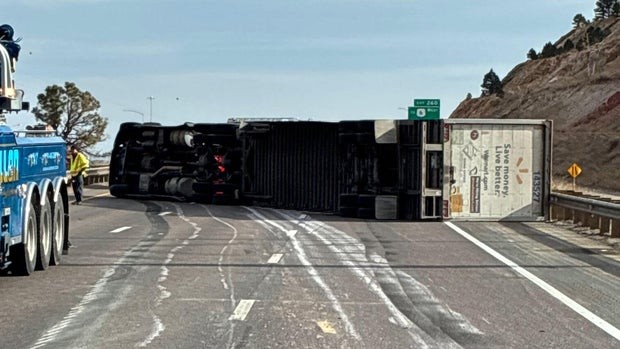
Four separate semi-truck rollovers occurred on a 30-mile stretch of Interstate 25 between Fort Collins and the Wyoming state line. High winds closed I-25 in both directions, and paramedics transported one semi-truck driver to the hospital.
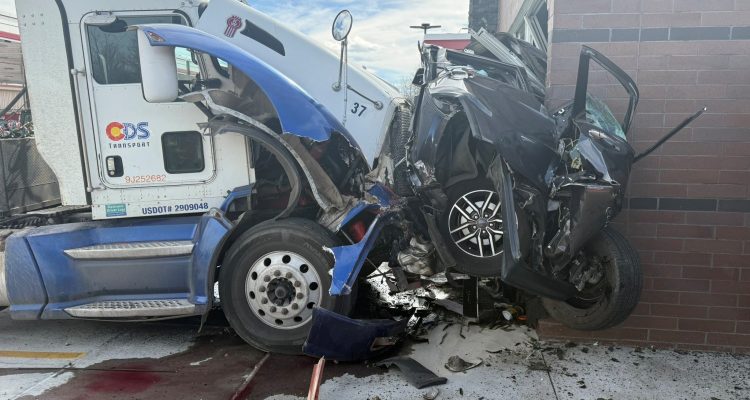
On Highway 93 near Boulder, two additional semis tipped over, one of which struck a power pole and involved a collision with a passing passenger vehicle.
Finally, a rollover on I-70 near Lookout Mountain spilled 30 gallons of fuel on the road.
High winds also blew over several semi-trucks that had stopped on the side of the highway to wait out the storm before drivers could move them to cover.
These crashes come soon after the catastrophic 36-vehicle pileup on I-25 south of Pueblo on February 17, 2026 killed five people and sent 29 others to the hospital. High winds drove blowing dirt across the highway, creating what the Colorado State Patrol called brownout conditions that dropped visibility to near zero. Seven semis were among the 36 vehicles involved. The Colorado Department of Transportation issued a high wind warning, but the dust storm rapidly moved in.
What Federal Law Requires of Truck Drivers in Hazardous Conditions
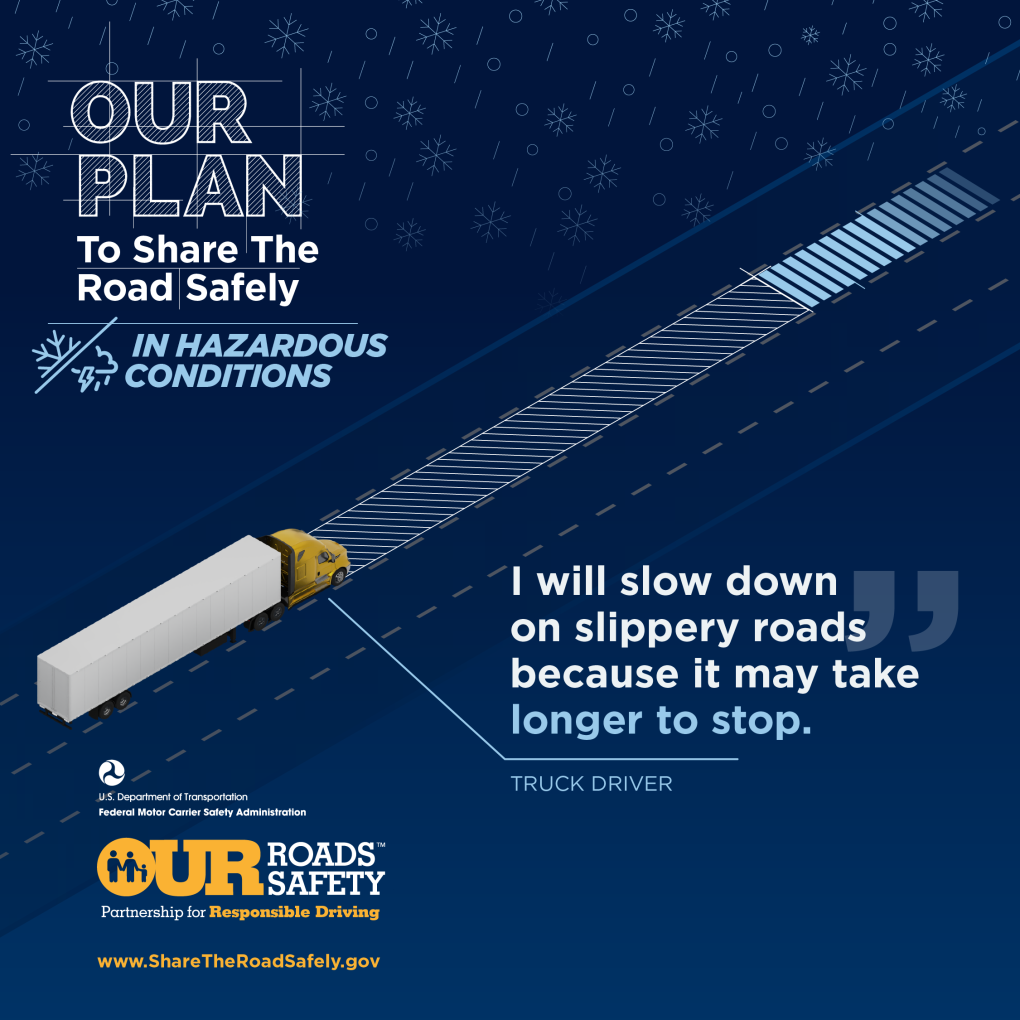
The Colorado Department of Transportation (CDOT) and the FMCSA both require semi-truck drivers to modify their driving in adverse weather conditions. Under 49 CFR § 392.14, a Colorado semi-truck driver must exercise extreme caution whenever hazardous conditions caused by snow, ice, sleet, fog, mist, rain, dust, or smoke adversely affect visibility or traction. The regulation requires drivers to reduce speed when such conditions exist. If conditions become sufficiently dangerous, the driver must stop driving and not resume until conditions improve.
While semi-truck drivers have some discretion over how they react to adverse weather conditions, at a minimum they should reduce their speed until conditions improve. The FMCSA recommends semi truck drivers slow by 1/3 on a wet road or 1/2 on snow packed roadways.
The trucking industry knows these dangers and motor carriers have a responsibility to ensure their drivers are trained and experienced enough to deal with adverse conditions when they arise. This includes not only having the training to operate in snow, rain, or high winds, but also to recognize when the conditions are severe enough to stop.
Drivers also need to be secure enough and supported by a motor carrier so that they can stop without fear of penalty or reprimand. Section 390.6 of the Federal Motor Carrier Safety Regulations prohibit motor carriers from forcing or influencing drivers to operate under conditions that they know are unsafe.
Colorado Driving Can Present a Wide Array of Hazardous Conditions
Denver semi-truck crash attorneys know Colorado’s roadways present a wide array of hazardous driving conditions. The I-70 and I-25 corridors can run the gamut of challenging weather to even the most experienced drivers. The best truck crash attorneys know it is possible for a semi-truck driver to experience each hazard outlined in section 392.14 in a single day if their route takes them across Colorado!
Every Colorado driver understands snow and ice can create traction problems and cause car accidents. Heavy commercial trucks face these dangers at an even greater magnitude. A fully loaded semi requires substantially longer stopping distances than passenger cars under ideal conditions. On ice or packed snow, brake fade and trailer swing become serious risks.
As the recent I-25 crashes demonstrated, high winds are a persistent and underappreciated threat. Tractor-trailers, with their large flat-sided trailers acting as sails, are particularly vulnerable, with 40-60 mph wind gusts capable of tipping a fully loaded semi-truck and trailer on its side:
Wind gusts of that strength are not uncommon along Highway 93, Interstate 25 north of Denver, and the Eastern Plains corridors. A Colorado high wind truck crash can close highways for hours and involves special risks of fire from spilled fuel. Dust and smoke, as seen in the Pueblo brownout crash, can have similar effects across the Eastern Plains during dry conditions.
Fog can quickly appear along Denver’s I-25 corridor, Colorado’s river valleys, and even its mountain passes. Low-lying fog can reduce visibility to near zero in seconds. The Colorado Commercial Driver’s License (CDL) Manual bluntly instructs drivers that the best advice for driving in fog is to simply don’t.
As the Colorado CDL manual explicitly cautions, extreme heat creates its own risks, particularly for tires already stressed by weight and long hauls. Air pressure increases as the temperature climbs requiring drivers to check tires every 100 miles. This can cause dangerous blowouts leading to a loss of control in mid-summer Denver heat.
Responsible Motor Carriers Train their Drivers and Monitor Routes for Adverse Weather
Federal regulations place the obligation for safe driving in the moment on the driver. But the trucking company bears ultimate responsibility for ensuring the driver is experienced and trained to operate safely under hazardous conditions. Under section 391, motor carriers must ensure that drivers they put on the road are qualified and trained to handle any conditions they may face.
A motor carrier that dispatches a driver into a forecast high-wind event on the Eastern Plains or routes them through I-70’s mountain corridor without proper training on hazardous weather operations bears as much responsibility for the crash as the driver. While a trucking company that pressures its drivers to push through high winds or hazardous weather to meet delivery deadlines will ultimately be responsible for any crash.
Driver training programs must specifically address hazardous weather driving, including how to recognize the warning signs of deteriorating visibility, when to pull off the road, and how to secure the vehicle safely. Carriers that skip or minimize this training to reduce cost cut a corner that can be fatal. When a driver lacks the skill or instruction to handle Colorado’s conditions and a crash results, the carrier’s failure to train is a direct source of liability in a Colorado hazardous weather truck accident case.
How a Denver Truck Crash Lawyer Builds a Hazardous Weather Case
With the size and forces involved in semi-truck crashes, the potential for catastrophic personal injury and property damage are high. Truck accident injuries can require surgeries, long term medical treatment, physical therapy, and home care.
Hazardous weather truck crash cases require more than proving the weather was bad. The best truck crash lawyers know insurance companies and defense attorneys will argue that these crashes are no one’s fault due to the conditions. That is why you need an experienced and knowledgeable team of Denver semi-truck crash lawyers to have your back.
The true cause of a hazardous weather crash can lie in the actions of the trucking company in the days and weeks leading up to the crash. Beyond exploring weather conditions and driver training and experience, you must be prepared to dig into the motor carrier to determine whether they pressured or coerced their drivers into taking unacceptable risks.
Trucking companies can force drivers to make tight delivery windows, structure their pay in ways that force drivers to make dangerous decisions about how long and under what conditions they must keep driving. These factors can contribute to semi-truck crashes as much or more than brake and maintenance issues.
Pay structures, maintenance records, and internal communications will be just as important as weather records, NWS wind data, and CDOT advisory logs in high wind or hazardous weather crashes. Driver logs and trip sheets can show whether the driver was aware of weather advisories. Dispatch communications can reveal whether the carrier pressured the driver to continue driving against the driver’s better judgment. You need a team of Denver truck accident attorneys prepared to fight for these records and who have the knowledge to find the underlying causes of high wind or hazardous weather crashes.
If you or a loved one has been seriously injured or killed in a truck crash in Colorado, you need a legal team with the experience and track record to handle complex commercial trucking cases. You cannot simply find any personal injury attorney and expect to get the compensation you deserve from a trucking company and its insurance carrier. The attorneys at Bowman Law, LLC have the experience and knowledge of federal trucking regulations necessary to handle complex truck accident claims throughout Colorado. Call Bowman Law, LLC, Colorado Truck Accident Lawyers, today at 720-863-6904 for a free consultation.
Carlo Bonavita
Carlo is a trial attorney who focuses heavily on trucking and transportation litigation. With more than seventeen years of experience handling complex civil cases, he has represented clients in matters involving trucking liability, product liability, insurance coverage disputes, and other high-stakes litigation. Carlo earned his J.D. from Seton Hall University School of Law in 2004 after completing his undergraduate studies at Fordham University in 2001.
Image: South Metro Fire Rescue A semi-truck hauling a heavy trailer reportedly lost its brakes traveling south on Santa Fe Drive in Littleton this week. The semi-truck driver exited Santa ...
Not necessarily. Research consistently shows that age alone is not the best predictor of crash risk for commercial truck drivers. Instead, health, fatigue, training, workload, and regulatory compliance play a ...
Yes. A contributing factor that frequently emerges in trucking crashes is driver inexperience. Although trucking companies are required to screen, train, and supervise commercial truck drivers, those safeguards do not ...


 Return to All News & Resources