Since this blog was first published, Denver Police have made an arrest in connection with the July 10 crash on East Colfax Avenue — and new details confirm the pedestrian died from their injuries. (Denver7, July 21, 2026)
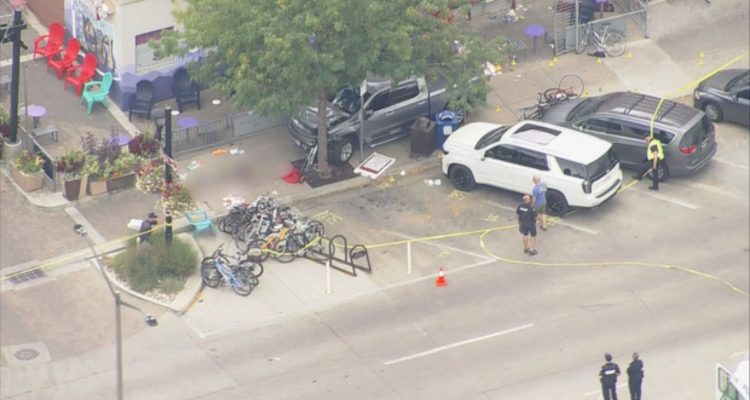
Denver Police announced Tuesday the arrest of 42-year-old Aaron Espinoza. Investigators say Espinoza was traveling eastbound on East Colfax in a white Ford SUV when he struck a pedestrian as he turned into an alleyway near York and Gaylord streets around 10:05 a.m. on July 10. Espinoza allegedly fled the scene. Investigators have since recovered the vehicle believed to be involved. The victim’s identity has not been released. Formal charges had not been announced as of this writing.
The original blog published July 10, 2026 continues below.
On Friday morning, July 10, 2026, Denver Police responded to the 2200 block of East Colfax Avenue after a vehicle struck a pedestrian. According to the Denver Police Department, the pedestrian suffered serious injuries. No further details about the circumstances of the crash or the condition of the driver have been released as of this writing. (FOX31/KDVR, July 10, 2026)
The investigation is ongoing. What is already clear is that another person has been seriously injured on one of Denver’s most dangerous corridors for people on foot.
If you or someone you know was injured in this crash, or in any pedestrian crash along the Colfax corridor, understanding your legal rights now can make a meaningful difference in what happens next.
Colfax Avenue: A Persistent Danger for Pedestrians
East Colfax Avenue has a documented history as one of Denver’s most dangerous stretches of road for pedestrians. FOX31/KDVR has reported that Colfax has recorded more deadly crashes than any other street in Denver, with pedestrian-involved crashes occurring regularly along its length. Denver’s own Crash Data Dashboard has shown that pedestrian crashes account for 25 percent of all deadly crashes in the city, and Colfax has led that list for multiple years running.
The pattern is not a coincidence. Colfax is a high-speed, high-volume arterial road with complex intersections, inconsistent lighting, frequent bus stops that place pedestrians in proximity to fast-moving traffic, and commercial uses that generate heavy foot traffic at all hours. People cross it every day on foot, and every day that crossing carries risk.
When a driver strikes a pedestrian on Colfax, it does not happen in isolation. It happens on a street where the conditions have been known to create danger, and where drivers have a heightened obligation to exercise care. We covered Denver’s most dangerous streets and what injured pedestrians can do in a recent piece for Westword — read it here.
What Colorado Law Requires of Drivers Around Pedestrians
Colorado law places affirmative obligations on drivers when pedestrians are present. Under C.R.S. Section 42-4-802, drivers must yield the right-of-way to pedestrians crossing in a marked or unmarked crosswalk at an intersection. Beyond crosswalks, drivers are required to exercise due care to avoid colliding with any pedestrian — regardless of whether that pedestrian is in a designated crossing area.
That standard — due care to avoid colliding with a pedestrian — is the foundation of liability in a pedestrian injury case. When a driver strikes a pedestrian, the central question is whether that driver was exercising the level of care the law requires given the conditions: the speed of the vehicle, the visibility, the time of day, the presence of pedestrian traffic, and the driver’s attention to the road.
On a street like East Colfax, where pedestrian activity is heavy and well-documented, a driver who strikes a person on foot faces serious questions about whether they were driving with adequate care for the environment they were in.
Serious Injuries and What They Mean for a Civil Claim
The Denver Police Department described the pedestrian’s injuries as serious. In personal injury law, serious injuries matter not just medically but legally — they define the scope of damages available in a civil claim.
Recoverable damages for a seriously injured pedestrian in Colorado can include:
All medical expenses, past and future, including emergency treatment, hospitalization, surgery, rehabilitation, and ongoing care
Lost wages and lost earning capacity if the injuries affect the victim’s ability to work
Pain and suffering, both physical and emotional
Loss of enjoyment of life if the injuries permanently affect the victim’s ability to participate in activities they valued
Costs of any long-term assistance or accommodations the injuries require
Serious injuries often have consequences that extend far beyond the initial hospitalization. Rehabilitation can take months or years. Some injuries result in permanent limitations. A civil claim that accounts only for immediate medical bills dramatically undervalues what the victim has actually lost.
The Driver’s Insurance Company Is Already Working
In the hours and days following a pedestrian crash, the at-fault driver’s insurance company begins its own investigation. Adjusters are trained to gather information, assess the claim, and look for ways to reduce the payout. They may contact the injured person or their family while the victim is still in the hospital.
Statements made to an insurance adjuster without legal counsel — however innocent they seem — can be used to complicate or reduce a claim. The adjuster represents the insurance company’s interests. An attorney represents the injured person’s.
Under C.R.S. Section 13-21-111, Colorado’s comparative negligence framework, a driver’s attorney or insurer may attempt to argue that the pedestrian shares some portion of fault for the crash — crossing outside a crosswalk, walking while distracted, or moving into traffic unexpectedly. Every percentage of fault assigned to the pedestrian reduces their recovery by that amount. Documenting the facts early, before that narrative takes hold, is one of the most important things a pedestrian victim can do.
Evidence That Exists Now and Will Not Last
The 2200 block of East Colfax Avenue is a commercial corridor with significant camera coverage. Evidence from this crash that needs to be preserved immediately includes:
Surveillance footage from businesses, parking lots, and ATMs along the 2200 block, which may overwrite within 24 to 72 hours without a preservation demand
Traffic camera footage from the City of Denver’s infrastructure along Colfax
Dashcam footage from nearby vehicles
The driver’s cell phone records, which can establish whether distraction was a factor
Event data from the vehicle involved, capturing speed and braking in the seconds before impact
Physical evidence at the scene, including skid marks, point of impact, and debris field
Witness statements from people in the area at the time of the crash
Denver Police will gather what they need for their investigation. A civil attorney gathers what the injured person needs for their claim — and those two sets of evidence are not always the same.
What If the Pedestrian Was Not in a Crosswalk?
This is one of the most common questions in pedestrian cases, and one of the most misunderstood. Colorado law does not require a pedestrian to be in a marked crosswalk to have a valid legal claim. Drivers owe a duty of care to pedestrians anywhere on or near a roadway.
If a pedestrian was crossing mid-block, walking along the road, or present in the roadway in any manner, the driver still had a legal obligation to exercise reasonable care to avoid a collision. The pedestrian’s location affects the fault analysis — it may reduce recovery under comparative negligence — but it does not eliminate the driver’s responsibility.
The specific facts of where the pedestrian was, what the driver was doing, and what either party could have done differently are questions for an investigation, not assumptions to be made from an initial police report.
If You Were Injured on East Colfax — or Anywhere in Denver
Bowman Law represents people seriously injured in pedestrian accidents throughout Denver and across the Front Range. We investigate early, preserve evidence, and fight for full compensation — not just the immediate medical bills, but the full scope of what a serious injury takes from a person’s life.
If you were injured in the July 10 crash on East Colfax, or in any pedestrian crash in Denver, the right time to ask questions is now. Evidence disappears. Insurance companies move fast. And your rights are worth protecting from the start.
Call us at 720-863-6904 or visit coloradopersonalinjuryhelp.com for a free and confidential consultation. There is no charge and no obligation.
Jerry Bowman
Owner and Managing Attorney
Jerry Bowman, J.D., M.A., Owner and managing attorney of Bowman Law LLC, takes his responsibility to the legal profession seriously and dedicates his time and effort to providing quality and competent legal representation to clients in Denver and throughout all of Colorado. He holds an MA in Political Science from Wayne State University and earned his law degree in two and a half years from Michigan State University College of Law.
At 8:15 p.m. on Friday, September 26, 2026, Aurora Police responded to a vehicle versus pedestrian crash near the intersection of South Peoria Street and East Tennessee Avenue. A 35-year-old ...
Around 9:15 p.m. on Monday, September 1, 2026, two men were crossing southbound Highway 287 on foot near West 66th Avenue in the Berkley area of Adams County when a ...
Source: CBS UPDATE — September 4, 2026 The Larimer County Coroner’s Office has identified the man killed in the August 29 Tour de Fat crash as Joshua Robert Douglass, 33, ...


 Return to All News & Resources