Return to All News & Resources

100 mph Through a Red Light in Greeley: Who Is Liable?
Around 9:40 p.m. on Friday, October 9, 2026, a motorcyclist traveling westbound on West 10th Street in Greeley was moving at more than 100 miles per hour when they ran ...
Keep Reading


Source: KMGH
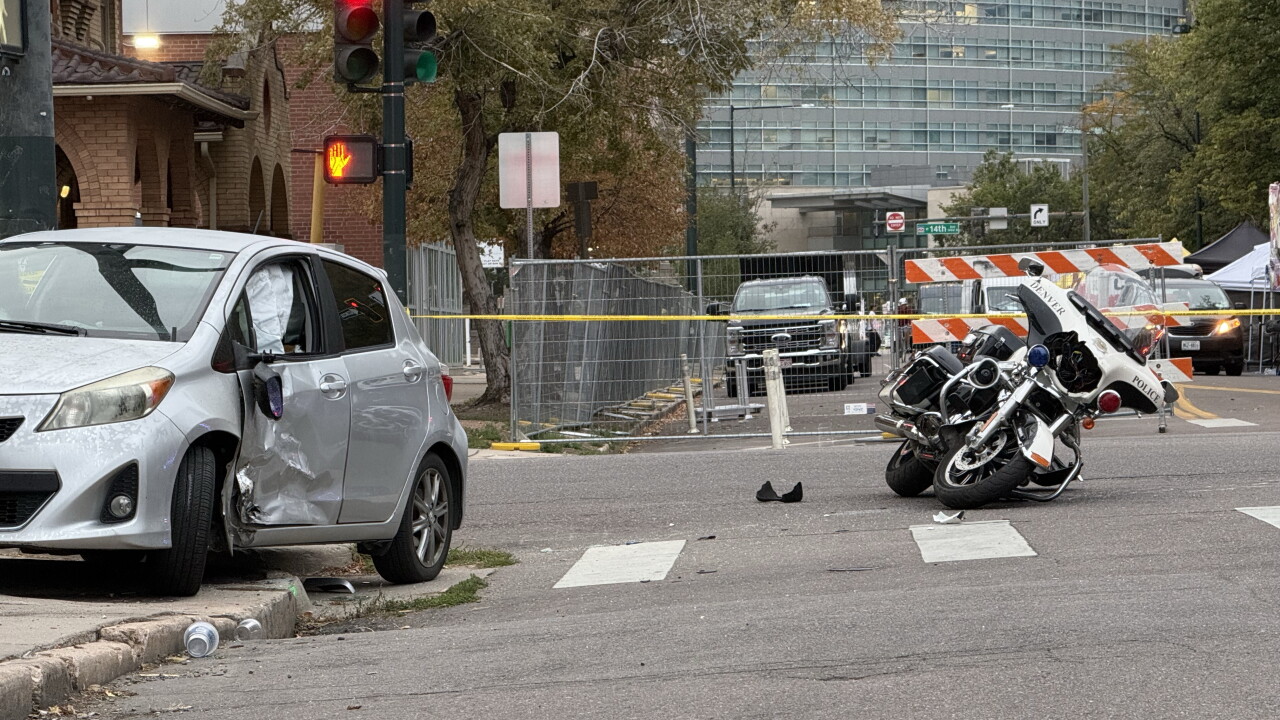
Thursday evening, September 25, 2026, a Denver Police Department motorcycle officer was responding to a call with lights and sirens activated when another vehicle collided with the officer near West 13th Avenue and Bannock Street in downtown Denver. The officer was injured and transported to a nearby hospital. The extent of the injuries has not been released. The driver of the other vehicle remained at the scene and is cooperating with the investigation. The intersection was closed while DPD investigated. (Denver7, September 25, 2026; FOX31/KDVR, September 25, 2026)
The investigation is ongoing. DPD has not released additional details about the circumstances of the crash, including what call the officer was responding to, the direction either vehicle was traveling, or the nature of the collision.
A law enforcement officer injured in the line of duty faces a legal landscape that is meaningfully different from a standard crash victim. Understanding that landscape matters — both for the officer and for civilians who find themselves involved in crashes with emergency vehicles.
Colorado law places clear obligations on all drivers when an emergency vehicle is approaching with lights and sirens activated. Under C.R.S. Section 42-4-705, drivers must immediately move to the right edge of the roadway and stop when an authorized emergency vehicle using audible and visual signals approaches. The driver must remain stopped until the emergency vehicle has passed.
On a downtown Denver street like West 13th Avenue, that obligation applies regardless of traffic signals, lane configurations, or the direction the emergency vehicle is approaching from. When a police motorcycle with lights and sirens is responding to a call, every other vehicle on the road has a legal duty to yield.
Whether the driver who collided with the officer on Thursday complied with that duty is the central question investigators are examining. The driver’s cooperation is noted — but cooperation after the fact does not resolve the question of what happened in the moments before the collision.
When a law enforcement officer is injured in the line of duty, two separate legal frameworks apply simultaneously.
The first is workers’ compensation. Under C.R.S. Section 8-41-401, Colorado’s workers’ compensation system covers medical expenses and a portion of lost wages for employees injured on the job, including law enforcement officers injured while on duty. For a DPD officer hurt while responding to a call, workers’ comp is the immediate source of coverage for medical bills and income replacement during recovery.
Workers’ compensation, however, does not cover everything. It does not compensate for pain and suffering, permanent injury, or the full value of a serious long-term physical impairment. That is where the second framework comes in.
An officer injured by a civilian driver’s negligence may have an independent civil claim against that driver — separate from and in addition to workers’ comp. Whether that civil claim is viable depends on the specific facts of what the driver did or failed to do, and how the fault analysis plays out under Colorado’s comparative negligence framework.
Under C.R.S. Section 13-21-111, Colorado’s modified comparative negligence framework, an officer who was responding to a call lawfully and was struck by a driver who failed to yield bears little or no fault for the collision. The driver who failed to yield is the at-fault party — and that driver’s liability insurance is a source of compensation for the officer’s injuries beyond what workers’ comp provides.
This crash is also instructive for any driver who finds themselves in a situation where they have collided with a police vehicle or other emergency responder. Staying at the scene — as the driver in Thursday’s crash did — is both the legal requirement and the right thing to do.
Under C.R.S. Section 42-4-705, failure to yield to an authorized emergency vehicle is a traffic offense. If that failure results in injury to the officer, additional charges become possible — including careless driving causing injury. The driver’s cooperation with the investigation does not resolve their potential civil liability to the officer, but it is a relevant factor in how the legal process unfolds.
For civilian drivers who are genuinely confused about what to do when a police vehicle appears with lights and sirens — particularly in complex downtown intersections like those around West 13th Avenue — the answer is always the same: pull to the right and stop. If the vehicle is coming from behind, move right and stop. If the vehicle is approaching from ahead, stop and let it pass. If the intersection is already committed, stop as soon as safely possible.
DPD’s internal investigation, alongside any traffic investigation, will examine:
• Whether the other driver had visual and audible notice of the officer’s approach before the collision
• The speed and direction of both vehicles at the time of impact
• The traffic signal status at West 13th Avenue and Bannock Street
• Any surveillance or traffic camera footage capturing the moments before the crash
• Dashcam footage from the police motorcycle, if equipped
• Witness accounts from bystanders in the Civic Center area
• Event data from both vehicles
The officer’s injuries, whatever their ultimate severity, will also be documented through hospital and medical records — establishing the foundation for any civil claim the officer may choose to pursue in addition to workers’ comp benefits.
DPD has confirmed the crash and the officer’s hospitalization but has not released the officer’s identity, the extent of injuries, or further investigative details. This blog does not speculate about fault or whether charges will be filed against the civilian driver.
What the confirmed facts establish is that a DPD motorcycle officer responding to a call with lights and sirens was struck by another vehicle in downtown Denver Thursday evening. That officer has legal rights — under workers’ comp and potentially in civil court — that are worth understanding.
Bowman Law handles serious motorcycle accident cases and motor vehicle accident cases throughout Denver and across Colorado, including cases involving law enforcement officers and emergency vehicle crashes. Whether you are the injured officer, a civilian driver involved in the collision, or someone seeking to understand your rights after a similar incident, we are available for a confidential consultation at no charge and no obligation.
Call us at 720-863-6904 or visit coloradopersonalinjuryhelp.com whenever you are ready.

Owner and Managing Attorney
Jerry Bowman, J.D., M.A., Owner and managing attorney of Bowman Law LLC, takes his responsibility to the legal profession seriously and dedicates his time and effort to providing quality and competent legal representation to clients in Denver and throughout all of Colorado. He holds an MA in Political Science from Wayne State University and earned his law degree in two and a half years from Michigan State University College of Law.
Around 9:40 p.m. on Friday, October 9, 2026, a motorcyclist traveling westbound on West 10th Street in Greeley was moving at more than 100 miles per hour when they ran ...
Keep Reading
Just before 10:30 p.m. on Friday, August 22, 2026, a motorcyclist was killed in a single-vehicle crash on the eastbound Highway 58 flyover to Interstate 70 in Wheat Ridge. Officers ...
Keep Reading
In 2025, 149 motorcyclists died on Colorado roads. Of those riders, 66, nearly half, were not wearing a helmet at the time of the crash. Motorcycle fatalities accounted for more ...
Keep Reading