Return to All News & Resources

100 mph Through a Red Light in Greeley: Who Is Liable?
Around 9:40 p.m. on Friday, October 9, 2026, a motorcyclist traveling westbound on West 10th Street in Greeley was moving at more than 100 miles per hour when they ran ...
Keep Reading


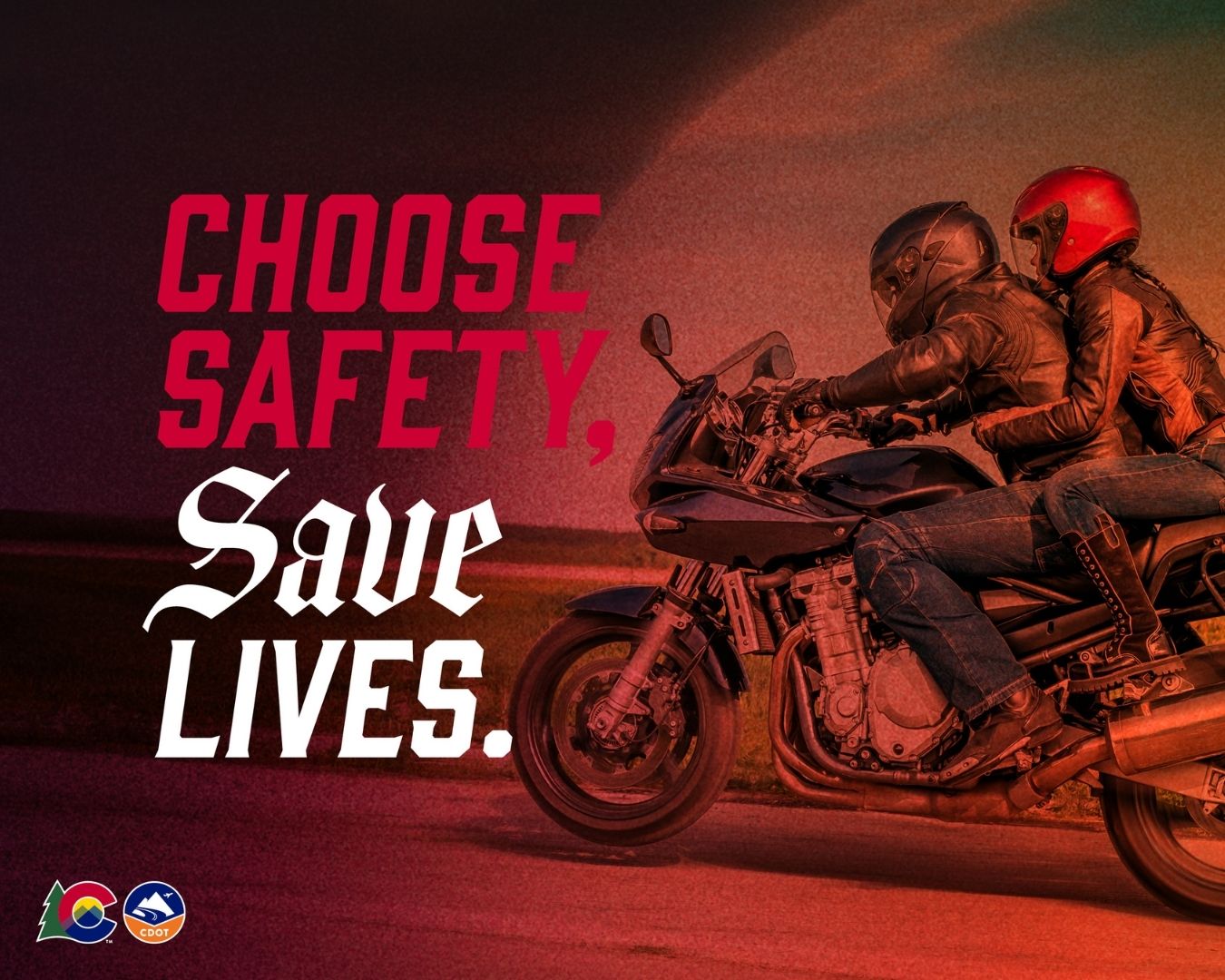
In 2025, 149 motorcyclists died on Colorado roads. Of those riders, 66, nearly half, were not wearing a helmet at the time of the crash. Motorcycle fatalities accounted for more than a fifth of all traffic deaths in Colorado that year.
Those are not abstract numbers. They are 149 families who got a knock on the door. 149 bikes parked in garages they will not leave again. And, as CDOT’s Motorcycle Safety campaign frames it, 149 loved ones who left behind people wishing they were here.
The season for these crashes is right now. Colorado’s riding season peaks in summer. The data shows motorcyclists face more risk than most other road users.
Motorcyclists are 28 times more likely to die in a crash than passenger vehicle occupants. CDOT reports this in its 2025 Motorcycle Safety data. That gap does not exist because riders are reckless. It exists because of physics.
A motorcycle offers no structural protection in a collision. The rider is the crumple zone.
The 9.6% decrease in fatalities from 2024 to 2025 is real progress. It is not enough. Motorcycle fatalities still make up 21% of all Colorado traffic deaths. This share is far higher than motorcycles’ share of miles traveled.
The helmet data is particularly stark. Of the 149 riders killed in 2025, 44% were not wearing a helmet.
CDOT notes that helmets reduce the likelihood of fatal head injuries by 37%. That is not a marginal improvement. A helmet is the single highest-impact safety decision a rider makes before turning the key.
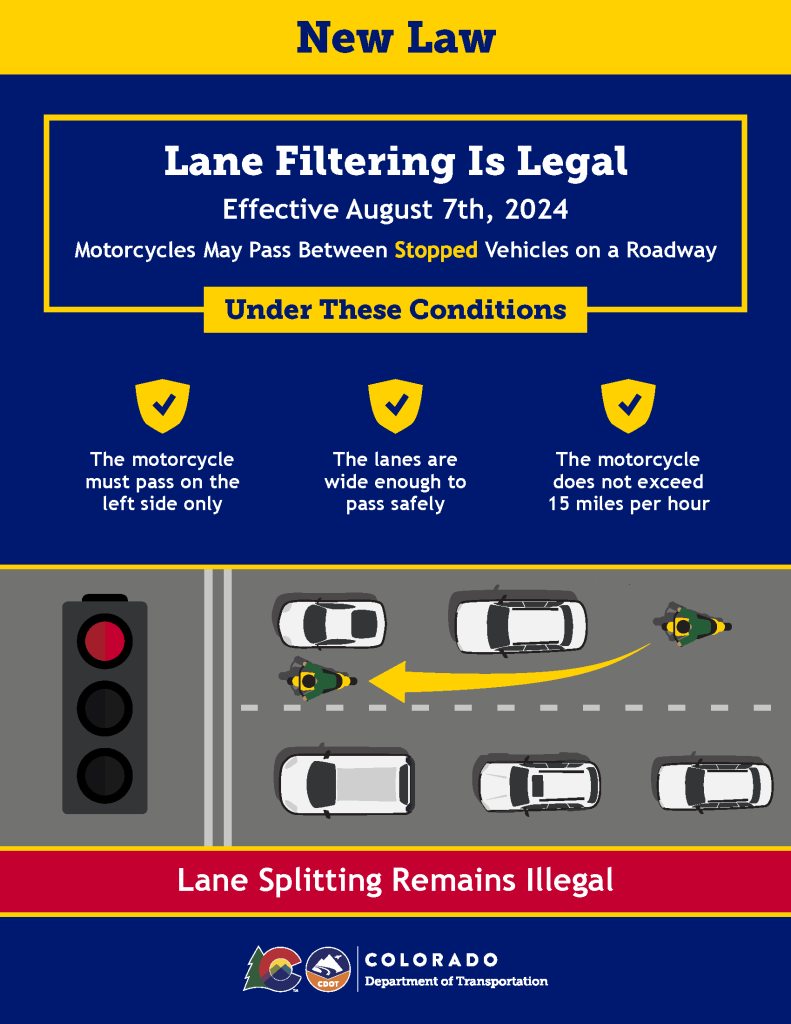
One of the most significant developments in Colorado motorcycle law in recent years took effect on August 7, 2024. Governor Polis signed Senate Bill 24-079 into law on April 4, 2024. It allows motorcyclists to pass between vehicles stopped on the road.
People call this lane filtering, and it differs from lane splitting.
Lane filtering allows a motorcyclist to move through stopped traffic traveling in the same direction. Lane splitting, which remains illegal in Colorado, involves riding between lanes of moving vehicles. The distinction matters both for safety and for legal exposure.
Five rules govern lane filtering under Colorado law:
1. Traffic must be at a complete stop before a rider passes.
2. The lane must be wide enough to fit both the vehicle and the motorcycle safely.
3. The motorcycle must travel at 15 mph or less while filtering.
4. The rider must pass safely and maintain control.
5. The rider must pass on the left and must not enter the oncoming traffic lane.
Why does this matter beyond the rules themselves? Because lane filtering directly reduces the risk of rear-end collisions.
Rear-end crashes are among the most dangerous a motorcyclist can experience. When a rider is stopped in traffic and a driver does not see them or stop in time, the result is often catastrophic. Lane filtering gives riders a legal tool to remove themselves from that exposure.
CDOT’s lane filtering resource page provides additional detail on the law and its application.
Understanding how crashes happen is the first step toward preventing them, and toward understanding legal liability when prevention fails.
CDOT data consistently points to a few primary contributors. The most common crash between cars and motorcycles happens when a car pulls out or turns left. The driver often does not see the rider.
Motorcycles are smaller than other vehicles. They move through spaces drivers may not always watch.
Blind spots, other vehicles, or distracted driving can hide them. This failure to yield is often the key factor in serious motorcycle crashes. It is the car driver’s failure, not the motorcyclist’s.
Other contributing factors include driver distraction, tailgating, and failure to check blind spots when changing lanes or merging. Each of these is a driver behavior failure with legal consequences when it causes injury.
For riders, CDOT lists impaired riding, speeding, and not wearing protective gear as preventable causes of serious injuries. Riding beyond your skill level, not signaling, and not riding defensively also show up often in crash data.
Colorado law requires a valid motorcycle license.
You may also use a motorcycle endorsement on your current driver’s license.
You need either one to legally ride a motorcycle on public roads. Riders who want to build skills can find safety courses through the Colorado Motorcycle Operator Safety Training (MOST) program run through the Colorado State Patrol.
Safety tips matter. But if a crash happens because another driver did not see a rider, legal rights still matter.
Colorado’s modified comparative negligence law, C.R.S. 13-21-111, lets an injured motorcyclist recover compensation as long as their share of fault is 50% or less. That means a rider can still recover damages.
This is true even if they were not wearing a helmet.
It is also true if they were riding a little over the speed limit.
It can still apply if they filtered in a way that others dispute, as long as the evidence shows the other driver has a greater share of fault.
Insurance companies understand this. They also know people often view motorcyclists negatively in crashes. They will use any argument to reduce or deny a claim. Lack of protective gear, speed, lane position, and visibility choices all become arguments in the adjuster’s file.
What counters those arguments is evidence, gathered quickly, before it disappears.
Nearby businesses and intersections overwrite surveillance footage within days. The event data recorder in the at-fault vehicle records speed, braking, and steering before impact. It only works if the vehicle is kept before repair or disposal.
Witness accounts are clearest in the first hours. Physical evidence at the scene changes with traffic, weather, and road maintenance.
In a motorcycle crash, the timeline for preserving evidence is not just important. It is critical.
If you or someone you care about is in a motorcycle crash, the next steps affect recovery and legal rights.
Get medical attention immediately. Adrenaline masks pain. Traumatic brain injuries, internal injuries, and soft tissue damage may not be apparent at the scene. A gap in medical care gives the insurance company room to claim your injuries were not serious or came from something other than the crash.
Document the scene. Photographs of the road conditions, the vehicles involved, the point of impact, and any visible injuries. The other driver’s license, registration, and insurance information. Names and contact information for witnesses.
Do not give a recorded statement to the other driver’s insurance company before speaking with an attorney. Adjusters are trained to gather information that minimizes their exposure. What you say in that first call becomes part of the claim record.
Contact an attorney early. The at-fault driver’s insurance company opens a file the same day. The investigation that works against your claim starts immediately. Yours should too.
Bowman Law, LLC represents riders hurt in motorcycle crashes across the Front Range. We serve Denver, Wheat Ridge, Greeley, Aurora, Westminster, and nearby areas. We also handle wrongful death cases for families who lost a rider. The firm works on contingency, meaning no fee unless you recover compensation.
Contact Bowman Law at 720-863-6904 or request a free consultation. If a crash has already happened, the most important thing you can do is act before evidence disappears and deadlines approach.
Ride safe. And if someone else’s failure to ride or drive safely puts you in harm’s way, know that you have rights worth protecting.
Sources: CDOT Motorcycle Safety | CDOT Lane Filtering Resources | Senate Bill 24-079 | Colorado MOST Program | C.R.S. 13-21-111, Comparative Negligence

Cameron joined Bowman Law in October of 2013 and has gained invaluable work experience as a paralegal for over a decade. Since this time, he has thoroughly enjoyed the challenging work that personal injury law presents. Although he now works as the firm’s COO, Cameron recognizes the many issues and troubles clients are faced after a personal injury.
Around 9:40 p.m. on Friday, October 9, 2026, a motorcyclist traveling westbound on West 10th Street in Greeley was moving at more than 100 miles per hour when they ran ...
Keep Reading
Source: KMGH Thursday evening, September 25, 2026, a Denver Police Department motorcycle officer was responding to a call with lights and sirens activated when another vehicle collided with the officer ...
Keep Reading
Just before 10:30 p.m. on Friday, August 22, 2026, a motorcyclist was killed in a single-vehicle crash on the eastbound Highway 58 flyover to Interstate 70 in Wheat Ridge. Officers ...
Keep Reading