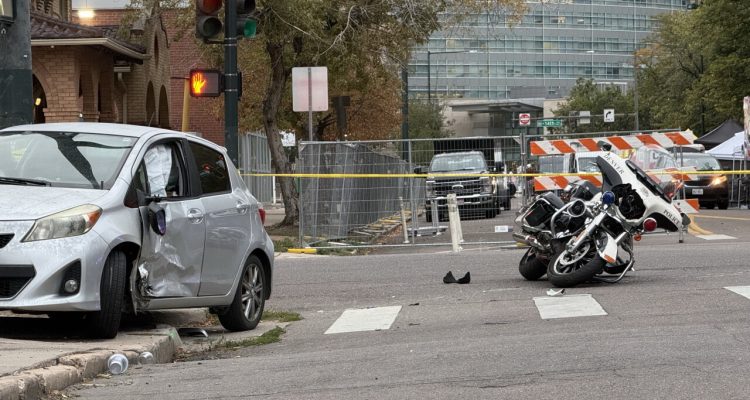
Around 9:40 p.m. on Friday, October 9, 2026, a motorcyclist traveling westbound on West 10th Street in Greeley was moving at more than 100 miles per hour when they ran a red light at the intersection of 35th Avenue. The motorcycle struck a vehicle traveling southbound on 35th Avenue. The impact triggered a five-vehicle crash and started a fire.
When first responders extinguished the fire and reached the scene, the 19-year-old male driver of the southbound vehicle was pronounced dead. The motorcyclist was also pronounced dead. Three other vehicles were involved.
The identities of both people who were killed are being withheld pending family notifications by the Weld County Coroner’s Office.
Two families are now confronting a loss that arrived without warning on a Friday night in Greeley. A 19-year-old who had somewhere to be at 9:40 p.m. is gone. The legal questions that follow are complicated by the fact that both drivers died — and by the chain reaction that pulled three more vehicles into the crash.
What the Evidence Already Shows
The Greeley Police Department’s preliminary investigation identified one central fact: the motorcyclist was traveling over 100 miles per hour in what appears to be a posted 35-mile-per-hour zone on 10th Street. At that speed, the motorcycle ran a red light and entered the intersection.
Colorado law requires all drivers to obey traffic control signals under C.R.S. Section 42-4-601. Running a red light is a clear violation of that statute. Colorado’s basic speed law under C.R.S. Section 42-4-1101 also requires all drivers to travel at a speed reasonable and prudent for the conditions — a standard that 100 miles per hour on a city street does not meet under any interpretation.
Beyond the traffic violations, operating a motorcycle at triple the speed limit on a city street and running a red light almost certainly qualifies as reckless driving under C.R.S. Section 42-4-1401 — willful or wanton disregard for the safety of others. That classification matters significantly for the families of all five vehicles involved in this crash.
The 19-Year-Old Driver’s Family: A Strong Legal Position
The 19-year-old man driving southbound on 35th Avenue had a green light. He was in his lane. He had no meaningful ability to perceive or avoid a motorcycle approaching the intersection at over 100 miles per hour. His fault in this crash is zero.
For his family, Colorado’s wrongful death statute, C.R.S. Section 13-21-202, provides the right to seek compensation for the full scope of losses his death caused. Those losses include medical and emergency costs before death, funeral and burial expenses, the income and financial support he would have provided over his lifetime, and noneconomic damages including grief, loss of companionship, and emotional suffering.
At 19 years old, the economic loss calculation extends over a lifetime of potential earnings and contributions. The noneconomic losses are no less real for being hard to quantify. Both are recoverable under Colorado law.
Because the conduct that caused this crash — 100 mph through a red light on a city street — constitutes reckless driving, the family may also have grounds for exemplary damages under C.R.S. Section 13-21-102. Colorado allows exemplary damages when a defendant’s conduct demonstrates willful and wanton disregard for others’ safety. The facts described in this crash come very close to that standard.
The Motorcyclist’s Family: A More Complex Situation
The motorcyclist also died. Their family is also grieving. And their situation is legally distinct from the other victims.
Under C.R.S. Section 13-21-111, Colorado’s comparative negligence framework, a party who bears more than 50 percent of the fault for a crash cannot recover. The motorcyclist’s conduct — operating at over 100 mph and running a red light — represents the primary cause of this crash. That fault share almost certainly exceeds 50 percent.
That does not mean the motorcyclist’s family has no options at all. If the investigation reveals any contributing factor from another source — a road defect, a signal malfunction, or some other circumstance the investigation has not yet addressed — those possibilities deserve examination before any legal door is closed. But based on the facts as currently reported, the motorcyclist’s estate’s ability to recover from the other vehicles is very limited.
The Three Other Vehicles: Innocent Parties in a Chain Reaction
Three additional vehicles were pulled into this crash by the initial collision and fire. Their occupants had no role in causing what happened and no reasonable opportunity to avoid being involved.
The drivers and passengers of those three vehicles are in a legal position similar to the 19-year-old’s family — their fault in this crash is zero or minimal. Their recoverable damages include vehicle damage, any physical injuries sustained, medical costs, and any other losses the crash caused.
Pursuing those claims requires identifying the motorcyclist’s insurance coverage, which will be one of the first steps in a civil investigation. If that coverage is insufficient, the occupants of the secondary vehicles should examine their own collision and uninsured motorist coverage as additional recovery sources.
Insurance and Coverage: What the Families Are Facing
Five vehicles. Two deaths. Multiple injuries from the fire and the secondary collisions. The insurance picture in a crash this large is complex.
The motorcyclist’s liability insurance is the primary source of compensation for all other parties. Motorcycle liability policies vary widely in their limits — and a policy that was adequate for a minor fender-bender is not adequate for a crash that killed a 19-year-old and injured occupants of three other vehicles.
When the motorcyclist’s coverage is exhausted across multiple claims, each affected party should look to their own underinsured motorist coverage. If the motorcyclist was operating without insurance — which is a real possibility in cases involving extreme speed and risk-taking behavior — uninsured motorist coverage becomes the primary source for all other parties.
The statute of limitations for wrongful death claims in Colorado is two years from the date of death under C.R.S. Section 13-80-102. For personal injury claims, the same two-year window applies. The evidence that supports these claims is most accessible now, in the days immediately following the crash.
What the Investigation Still Needs to Establish
Greeley Police have identified the speed and the red light violation as the primary factors. What the investigation has not yet determined includes:
• Whether alcohol or drugs played a role in the motorcyclist’s conduct
• The identity of the motorcyclist and any insurance coverage they carried
• The exact nature of the injuries sustained by occupants of the three secondary vehicles
• Whether any road conditions, signal timing issues, or infrastructure factors contributed in any way
• Event data from any of the five vehicles, which may capture speed and positioning in the moments before impact
Each of these findings shapes the liability picture and the available recovery for every family affected.
A Note on This Ongoing Investigation
The Greeley Police Department’s investigation is active. Neither victim has been publicly identified. Alcohol and substance involvement has not been determined. This blog does not speculate beyond what the confirmed facts establish.
What those facts establish is that a motorcyclist traveling at more than triple the posted speed limit ran a red light and killed a 19-year-old who had done nothing wrong. Three other vehicles were caught in what followed. Every family involved deserves a thorough understanding of what they can pursue — and the time to build that case is now.
If Your Family Was Affected by This Crash
Bowman Law handles serious motor vehicle accident cases and wrongful death claims throughout Greeley and across Colorado. Multi-vehicle crashes involving reckless conduct require early investigation to preserve evidence, identify all available insurance sources, and protect the rights of every party affected.
If your family lost someone in Friday night’s crash at 35th Avenue and 10th Street, or if you were in one of the other vehicles involved, we are available for a confidential conversation at no charge and no obligation.
Jerry Bowman, J.D., M.A., Owner and managing attorney of Bowman Law LLC, takes his responsibility to the legal profession seriously and dedicates his time and effort to providing quality and competent legal representation to clients in Denver and throughout all of Colorado. He holds an MA in Political Science from Wayne State University and earned his law degree in two and a half years from Michigan State University College of Law.
Source: KMGH Thursday evening, September 25, 2026, a Denver Police Department motorcycle officer was responding to a call with lights and sirens activated when another vehicle collided with the officer ...
Just before 10:30 p.m. on Friday, August 22, 2026, a motorcyclist was killed in a single-vehicle crash on the eastbound Highway 58 flyover to Interstate 70 in Wheat Ridge. Officers ...
In 2025, 149 motorcyclists died on Colorado roads. Of those riders, 66, nearly half, were not wearing a helmet at the time of the crash. Motorcycle fatalities accounted for more ...


 Return to All News & Resources