Complex regional pain syndrome is a chronic, often severe pain condition that can follow even a seemingly minor injury. In many cases, CRPS becomes a lasting disability affecting everyday life. For people injured in auto accidents, falls or other traumatic events, CRPS is one of the most challenging conditions a personal injury lawyer confronts. Our attorneys prepared this article to break down CRPS in personal injury law.
Complex regional pain syndrome matters in personal injury law because it represents not just an injury to a limb, but a systemic reaction involving nerves, pain pathways, blood vessels and tissue. The pain is typically out of proportion to the original injury, and when it becomes permanent it can impact employment, lifestyle, and long-term damages. Insurance companies frequently resist CRPS claims by questioning causation, permanency and credibility. That means you need strong documentation and expert medical testimony to show it is real and life-altering.
Types of Complex Regional Pain Syndrome
Complex regional pain syndrome generally divides into two main types:
Type I (formerly Reflex Sympathetic Dystrophy or RSD): Occurs after trauma or injury without confirmed damage to a specific nerve. About 90% of cases are type I.
Type II (formerly Causalgia): Occurs after a definite nerve injury (for example a cut, crush or laceration of a nerve).
While both types share very similar symptoms — burning pain, swelling, skin-temperature changes, altered hair and nail growth, stiffness, reduced movement — the key legal distinction is whether a definitive nerve injury is documented. That distinction may affect medical causation arguments in a personal injury case, but treatment approaches are similar.
Symptoms: What to Watch For
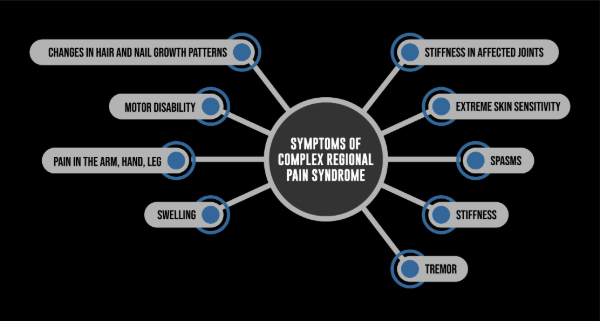
Complex regional pain syndrome presents a constellation of symptoms, often progressing from acute to chronic. Common signs include:
Persistent, burning or throbbing pain in an extremity (arm, leg, hand, foot) that is disproportionate to the original injury.
Extreme sensitivity to touch or cold (allodynia/hyperesthesia) and a feeling of “pins and needles.”
Swelling, changes in skin temperature (warm or cold compared to the other limb), skin discoloration (red, purple, pale) or altered texture (shiny, thin).
Changes in hair and nail growth in the affected region.
Joint stiffness, reduced range of motion, muscle weakness or atrophy, tremor or spasms.
In some cases, the condition spreads to other limbs beyond the original injured area.
Because CRPS can evolve and worsen over time, early recognition and intervention matter. Failure to treat promptly may increase the risk that the condition becomes chronic and far more difficult to manage.
What Causes Complex Regional Pain Syndrome?
According to Johns Hopkins Medicine, the exact cause of CRPS remains unclear, but research points to a multi-factorial process involving the peripheral and central nervous systems, inflammation, immune responses and vascular dysregulation.
Typical triggering events include:
A fracture, sprain or other trauma to a limb.
Surgery or invasive medical procedures.
Peripheral nerve injury (type II CRPS) or even a limb injury without clear nerve damage (type I).
Some studies suggest risk may increase with delayed treatment, immobilization, smoking or poor vascular supply, though these factors are still under investigation.
In a personal injury context, CRPS often arises after the initial accident injury appears to heal, but pain, swelling and dysfunction persist or worsen. That delayed onset can complicate causation discussions, making documentation and linking the CRPS back to the accident crucial.
Is CRPS a Permanent Disability?
In many cases, yes — CRPS can become a permanent impairment and disability. While there are instances of partial recovery or remission, a significant number of sufferers have ongoing symptoms, functional limitations and lifestyle changes.
From a legal viewpoint, when CRPS is declared “permanent,” it means the condition is unlikely to improve significantly with further treatment and has settled into a chronic state. At that point, the injury may support damages for long-term disability, lost earning capacity and pain and suffering.
Key factors in determining permanency include:
Stabilization of the condition (plateau of improvement)
Medical opinion from a specialist stating further meaningful recovery is unlikely
Continued functional limitations: inability to return to pre-accident job, activities of daily living or recreational pursuits
Because CRPS is unpredictable and varies in severity, it is often aggressively contested by insurers. Attorneys must clearly document evidentiary support and expert testimony to show permanency and disability.
Treatment Options for CRPS
There is no single “cure” for CRPS, but numerous interventions aim to reduce pain, improve function and limit disability. A multidisciplinary approach is standard.
Common treatment categories
Physical therapy and occupational therapy: Early movement, graded motor imagery, mirror therapy, desensitization techniques, functional restoration.
Medications: NSAIDs for mild inflammation; neuropathic pain medications (e.g., gabapentin, amitriptyline); corticosteroids; bisphosphonates; sometimes ketamine infusions in refractory cases.
Lifestyle and adjunctive care: Smoking cessation, vascular health, limb elevation, compression garments, early mobilization.
From a case-preparation standpoint, documenting the full treatment plan, response (or lack of response) over time, and ongoing limitations is critical. Lack of improvement despite aggressive therapy supports a permanency argument.
Settlements and Verdicts in CRPS Cases
CRPS claims are among the more valuable but also the more heavily contested personal injury cases. The amount varies dramatically depending on severity, treatment, disability, job loss, age, and how convincingly the case is presented.
Here are real-world examples:
A settlement of $11.5 million for a construction worker who developed CRPS in his left wrist after a power saw accident.
A settlement of $2 million for a woman who developed CRPS in her leg/foot after surgery and negligent post-op care.
A verdict of $2.4 million where a client developed CRPS after a procedure-related injury.
A law firm reporting settlements and verdicts ranging from six figures to over seven-figure outcomes for well-documented CRPS cases.
While there is no “average” settlement for CRPS (each case is unique) the value typically increases substantially when the injury is clearly permanent, thoroughly documented, and tied to marked functional limitations or job disability.
Why CRPS Matters in Personal Injury Cases
Complex regional pain syndrome is different from typical “soft-tissue” injuries. Its potential to cause permanent disability, chronic pain, lost employment, lifestyle changes and psychological harm elevates it into a significant claim. Insurance companies know this and often attempt to down-play causation or permanency.
Key reasons CRPS matters:
Causation: Linking the CRPS to the accident injury, not an unrelated condition, is critical.
Permanency: Demonstrating the condition is unlikely to improve further is a turning point in damages.
Work impact: CRPS may force career changes, reduce earning capacity or cause total job loss — increasing future damages.
Lifestyle impact: Beyond medical bills, CRPS affects hobbies, mobility, social life, mental health and independence.
Settlement leverage: Because of its severity, permanently disabling CRPS raises stakes and settlement value (and trial risk for insurers).
For injured persons in Colorado or elsewhere, having a lawyer who understands CRPS and can coordinate medical, vocational, and economic experts is essential.
If you or a loved one has suffered CSPR as a result of a Colorado car accident, contact our attorneys today at 720.466.2223 or email us for your free consultation. Our lawyers handle a wide range of personal injury cases, including Motor Vehicle Accidents, Bicycle Accidents, Pedestrian Accidents, Slip & Fall Accidents, and Dog Bites & Attacks. We service Arvada, Aurora, Boulder, Broomfield, Denver, Commerce City, Lakewood, Littleton, Thornton, Westminster, Wheat Ridge, and other parts of metropolitan Denver, Colorado.
Jerry Bowman
Owner and Managing Attorney
Jerry Bowman, J.D., M.A., Owner and managing attorney of Bowman Law LLC, takes his responsibility to the legal profession seriously and dedicates his time and effort to providing quality and competent legal representation to clients in Denver and throughout all of Colorado. He holds an MA in Political Science from Wayne State University and earned his law degree in two and a half years from Michigan State University College of Law.
After a serious car accident in Colorado, a personal injury victim typically follows a predictable insurance path. First, the victim pursues the at-fault driver’s bodily injury (“BI”) liability coverage. That ...
When is internal fixation surgery recommended after a car accident? Internal fixation surgery after a car accident becomes necessary when a fracture is severe enough that bones cannot heal without ...
When is cognitive rehabilitation recommended in personal injury cases? Cognitive rehabilitation is a structured therapeutic process designed to help individuals recover thinking skills, memory, concentration, problem-solving, and daily functioning after ...


 Return to All News & Resources