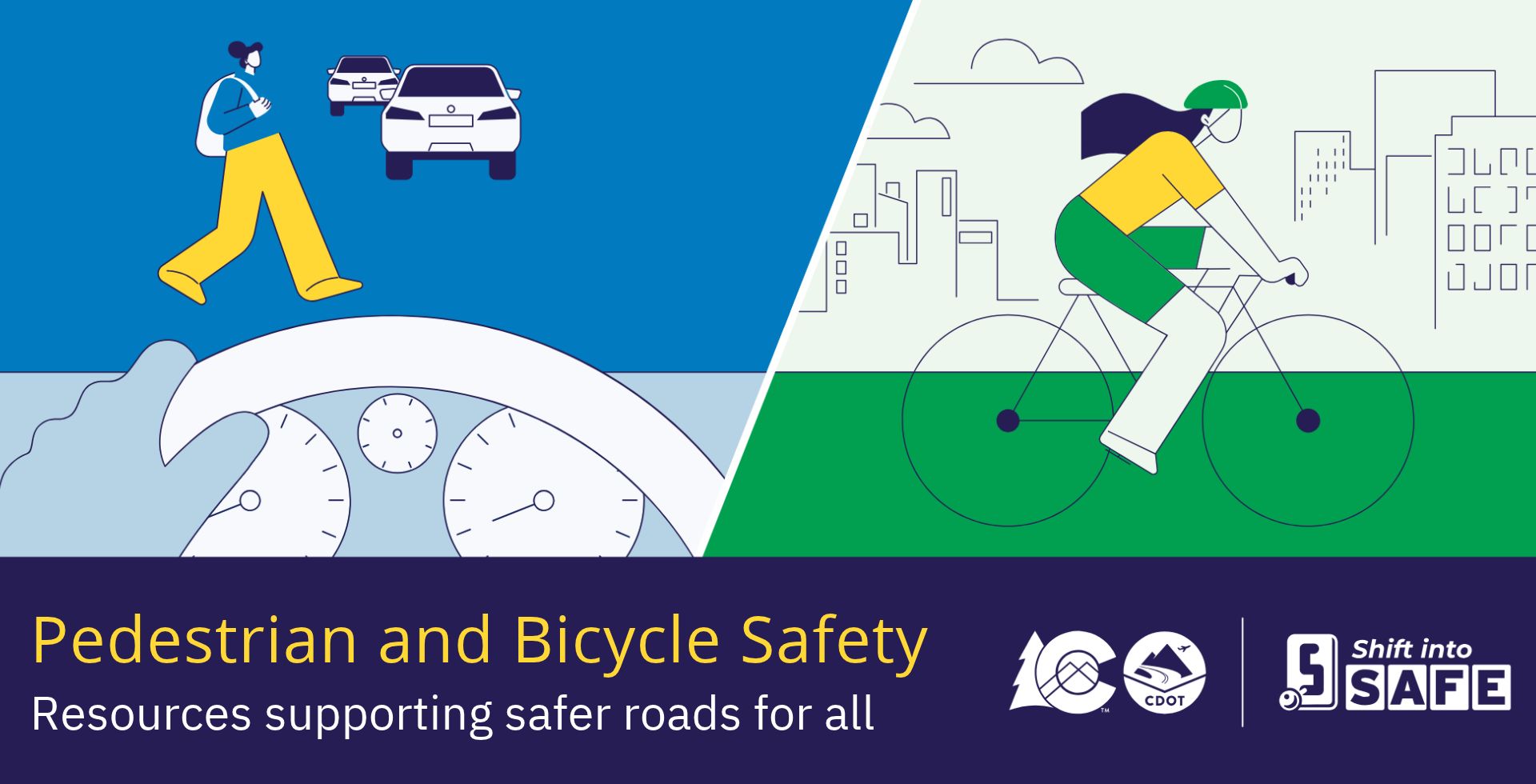
October is National Pedestrian Safety Month, a designation that reflects a troubling pattern: pedestrian fatalities spike in the fall and winter as days grow shorter and darker. It is also a fitting time to address bicycle safety, since the same conditions that put pedestrians at greater risk affect cyclists too. Pedestrian and bicyclist fatalities in Colorado have grown significantly over the past decade, and every person who walks, rides, or drives on Colorado roads has a role in reversing that trend.
This blog draws on data and guidance from the Colorado Department of Transportation (CDOT) to explain what the numbers show, what the law requires, and what every road user can do to make Colorado streets safer.
What the Numbers Tell Us
Pedestrian and bicyclist fatalities have increased dramatically in Colorado in recent years, according to CDOT’s Pedestrian and Bicycle Safety program. Together, pedestrians and bicyclists represent a significant share of the state’s total traffic fatalities, despite making up a small share of total vehicle miles traveled on Colorado roads.
The numbers nationally add important context. According to NHTSA, a pedestrian’s risk of death increases sharply with vehicle speed. At 23 miles per hour, the fatality risk is roughly 10 percent. At 42 miles per hour, it climbs to 50 percent. At 58 miles per hour, it reaches 90 percent. This is not a theoretical relationship. It is what determines whether a person struck by a car survives.
Alcohol plays a documented role in a large share of fatal crashes involving pedestrians and bicyclists, according to NHTSA data. The majority of pedestrian fatalities in Colorado occur in low-light conditions, and dark, dawn, and dusk account for a disproportionate share of deaths. These patterns point directly to the most preventable causes: speed, impairment, and reduced visibility.
What Colorado Law Requires
Colorado law establishes specific rights and duties for pedestrians, bicyclists, and drivers. Understanding those legal obligations matters both for road safety and for anyone who is injured when another road user fails to meet them.
For Drivers
Drivers are required to yield to pedestrians in crosswalks and intersections, including unmarked crosswalks, when it is safe to cross. Stopping in the crosswalk itself is prohibited. Under C.R.S. § 42-4-802, a driver must stop and remain stopped for a pedestrian who is crossing in or entering the crosswalk on the driver’s side of the road.
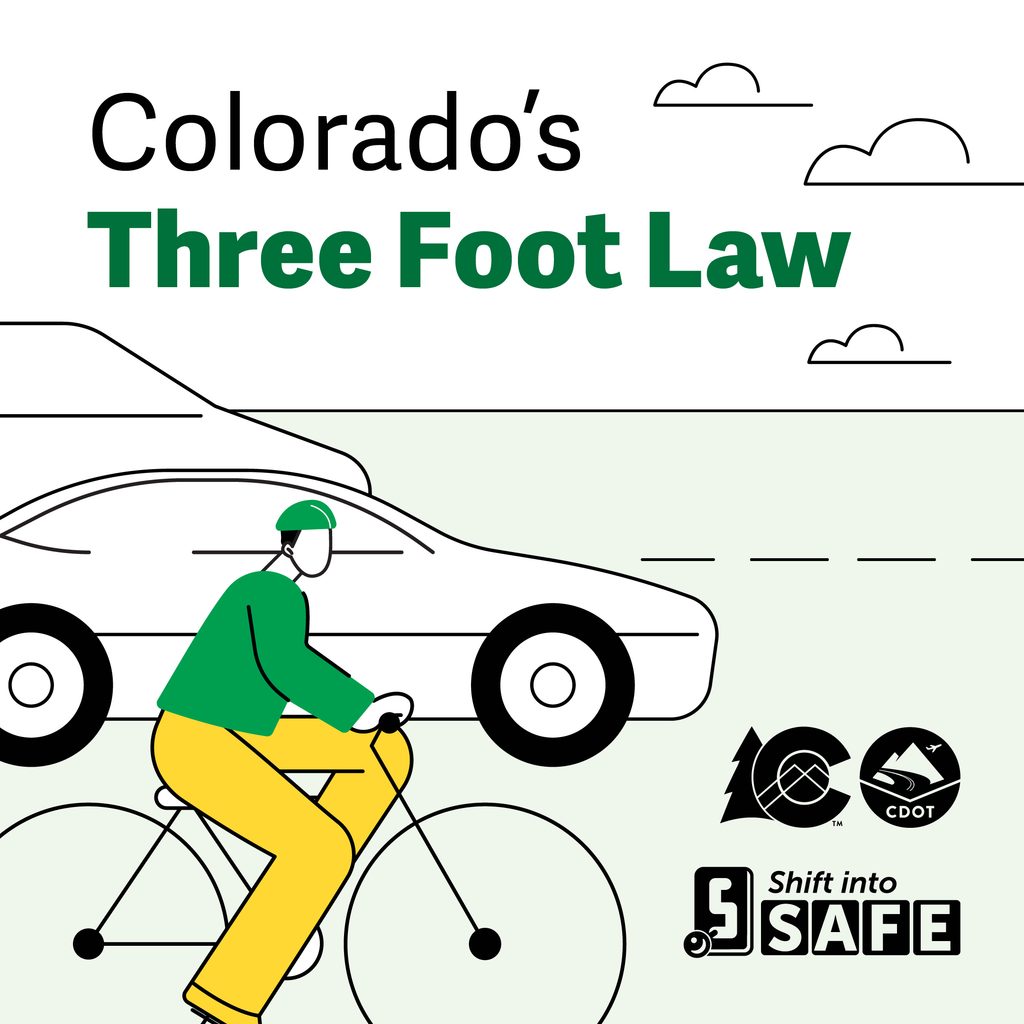
When passing a bicyclist, drivers and motorcyclists must give at least three feet of clearance. Under C.R.S. § 42-4-1002, if oncoming traffic or road conditions make a three-foot buffer impossible, the driver must slow down and remain behind the cyclist until it is safe to pass. Drivers must not underestimate a cyclist’s speed, particularly when turning across a bike lane or driveway.
Distracted driving remains one of the leading causes of crashes involving pedestrians and cyclists. Colorado law prohibits handheld mobile device use while driving, though hands-free accessories are permitted. Combined with speed and impairment, distraction creates the conditions where a predictable, preventable crash occurs.
At night, drivers should reduce speed and use headlights consistently, particularly in areas with limited street lighting near schools, parks, shopping areas, and transit stops.
For Pedestrians
Pedestrians have the right of way in crosswalks and intersections when signals indicate it is safe to cross, even without painted markings. However, pedestrians crossing outside a marked or unmarked crosswalk at an intersection must yield to all vehicles. It is illegal for pedestrians to cross between adjacent, signalized intersections except at a designated crossing. More detail on pedestrian rights and responsibilities is available at CDOT’s pedestrian and bicycle safety page.
Sidewalks must be used whenever available. When there is no sidewalk, pedestrians should walk on the road shoulder as far from traffic as possible. If no shoulder is available, pedestrians should walk on the left side of the road, facing oncoming traffic.
Before crossing at any crosswalk, CDOT recommends making eye contact with approaching drivers to confirm they have seen you before stepping into the road. Phones and other distractions should be set aside when crossing. At night, wearing bright or reflective clothing significantly improves visibility to drivers.
For Bicyclists
Bicyclists have the same rights and duties as drivers under Colorado law. They may use any public road except interstate highways, and drivers are required to share the road with them. When bike lanes or paved shoulders are available, cyclists should use them. When riding on the road, cyclists should stay as far right as safely possible and ride single file, unless riding side by side does not impede traffic or they are in a designated bike lane.
Colorado’s Safety Stop law, codified at C.R.S. § 42-4-1412.5, allows cyclists 15 and older to treat stop signs as yield signs and red lights as stop signs, provided it is safe to do so. This law also applies to e-bikes, scooters, skateboards, and electric personal assistance mobility devices. It is not permission to proceed without looking; it is permission to proceed when the intersection is clear.
Before turning, cyclists must signal by hand at least 100 feet in advance and yield to any pedestrians at the intersection. When riding on sidewalks or paths, cyclists must yield to pedestrians and give an audible signal before passing. Between sunset and sunrise, lights and reflectors are legally required.
Helmet use is strongly recommended regardless of age. Avoiding alcohol and drugs while riding is equally important. Both impair judgment, reaction time, and coordination in ways that can be fatal at the speeds involved in a collision.
The Three-Foot Law and the New Bike Lane Law
Two Colorado laws deserve particular attention. The three-foot passing rule under C.R.S. § 42-4-1002 is one of the most commonly violated laws involving cyclists. A driver who passes too close to a cyclist and causes a crash has violated this statute, which becomes evidence in any subsequent injury claim.
As of August 12, 2026, Colorado also prohibits stopping, standing, or parking in a designated bike lane under HB26-1237. A vehicle parked in a bike lane forces cyclists into moving traffic. When that forced merge leads to a crash, the driver who blocked the lane has violated a specific safety statute. That violation matters in court.
When Another Road User’s Failure Causes a Crash
When a driver fails to yield at a crosswalk, passes too close to a cyclist, runs a red light, or drives distracted and strikes a pedestrian or bicyclist, that failure is a legal breach of the duty every road user owes to others. Colorado law holds negligent drivers accountable for the harm they cause, and the specific traffic statutes they violated become part of the evidence.
These cases often involve serious and lasting injuries. Pedestrians and cyclists have no structural protection in a crash. Traumatic brain injuries, spinal damage, broken bones, and internal injuries are common outcomes. The legal and financial consequences extend well beyond the crash itself.
Cameron joined Bowman Law in October of 2013 and has gained invaluable work experience as a paralegal for over a decade. Since this time, he has thoroughly enjoyed the challenging work that personal injury law presents. Although he now works as the firm’s COO, Cameron recognizes the many issues and troubles clients are faced after a personal injury.
Source: Colorado Parks and Wildlife/Colorado Department of Transportation/ECO-Resolutions The camera footage is striking: elk, mule deer, black bears, coyotes, mountain lions, and bobcats moving quietly through a tunnel beneath one ...
Three Bowman Law attorneys have been recognized on the 2027 Colorado Super Lawyers lists, continuing a pattern of peer recognition that reflects what the firm has built over more than ...
Yes. A Colorado truck accident involves larger vehicles, stricter federal and state regulations, multiple potential defendants, and evidence that can disappear quickly, making both the injuries and the legal analysis ...


 Return to All News & Resources