Who is responsible for shoveling sidewalks and keeping walkways safe? Every winter in Colorado, the same quiet drama unfolds across neighborhoods, apartment complexes, and storefronts: snow piles up, ice settles in, and the question of responsibility hangs in the frosty air. When a sidewalk turns slick or a walkway becomes a hidden hazard, safety stops being a matter of convenience and becomes a matter of law.
Property owners, landlords, tenants, and businesses all play a role — but the lines are not always obvious. And in a state where winter conditions can change by the hour, knowing who is responsible for keeping walkways safe is not just good housekeeping. It is essential for preventing life-altering injuries and avoiding serious legal consequences. This is not just a matter of courtesy. This is a matter of law. And understanding those rules can help prevent injuries—and protect you from liability.
As a personal injury attorney, I make a living helping people after they have been hurt, but the truth is I would much rather see those injuries prevented altogether. You may be surprised to learn I do not want anyone slipping on ice, breaking a bone, or facing months of painful recovery. I see the aftermath of preventable hazards every day, and I share this information because I genuinely want people to be safe. Responsible snow and ice maintenance protects our communities, reduces avoidable harm, and keeps families out of the situations so many of my clients have endured. If that means fewer cases for me, that is a trade I’m more than willing to make. My goal is not to encourage lawsuits — it is to help property owners understand their responsibilities so injuries never occur in the first place.
The Colorado Premises Liability Act
Pursuant to Colorado’s Premises Liability Act (PLA), a “landowner” must take reasonable steps to keep people safe. A landowner is not just the person with their name on the deed. It includes anyone who controls the property or controls the snow and ice on it. That could be a homeowner, a landlord, a store owner, a property manager, or even an HOA.
Under the PLA, visitors fall into three categories: trespassers, licensees, and invitees. Customers and tenants’ guests fall under the “invitee” category. Landowners owe invitees the highest level of protection. When snow and ice accumulate, the PLA requires landowners to pay attention, act promptly, and prevent foreseeable injuries.
To hold a landowner responsible under the PLA, an injured person must show two things:
The landowner knew or should have known about the dangerous condition.
The landowner failed to use reasonable care to protect people from that danger.
“Reasonable care” means what an ordinarily prudent person would do under similar winter conditions. For snow and ice, that includes:
Regular inspections
Shoveling promptly/ regularly
Laying down salt, sand, or de-icer
Fixing obvious problems (like downspouts that create ice sheets)
Watching for melt/refreeze cycles
Providing warnings when hazards cannot be fixed quickly
If a property owner ignores these responsibilities and someone slips on snow or even black ice, the PLA allows that person to recover for their injuries.
Property Owner vs. Landlord
Many people confuse the roles between property owner and landlord, but the law treats them differently. A property owner holds title to the land or building. A landlord owns the property and leases it to someone else. The key question is control. If a lease says the tenant must remove snow, the tenant becomes responsible for keeping walkways safe. If the lease is silent, the law often assumes the landlord or property owner controls exterior maintenance.
In apartment complexes, the landlord or property manager nearly always handles snow removal because tenants do not control the sidewalks, parking lots, or shared stairs. In commercial settings, responsibility depends on the lease. Some business tenants must handle snow removal. Others rely on landlords. Either way, the person or company in control of the property at the time of the injury can face liability.
Business Owners vs. Snow-Removal Companies
Most business owners do not shovel their own sidewalks, and that is okay. Hiring a snow-plow or ice-mitigation company is common. But outsourcing does not eliminate responsibility. The business still needs to monitor conditions and make sure the contractor performs the job.
If the snow-removal company fails to show up or does substandard work, both the business owner and the contractor may share liability. The law focuses on who had the ability to prevent the danger. A business owner can shift some responsibility to the contractor through a well-written contract, but cannot escape all responsibility simply by hiring someone else.
Homeowners vs. Renters
If you own a home, you must keep your sidewalks clear. Most Colorado cities require shoveling within a set number of hours after snowfall stops—usually 24 hours. Failure to shovel can lead to fines and may expose you to liability if someone falls.
If you rent a home, your lease determines whether you or the landlord handles snow removal. Many landlords assign this duty to tenants renting a single-family home.
If you rent an apartment, snow and ice removal almost always falls on the landlord or property manager. Tenants aren’t expected to manage sidewalks, parking lots, shared stairs, or common entries.
Can the Injured Party Sue the Responsible Party?
Yes. A premises liability claim can be brought against the responsible person, business, landlord, property owner, or corporation individually. If the property is insured, the insurance company typically defends the case and pays the settlement or judgment up to the policy limits. But when insurance coverage is inadequate—or when a landlord, business owner, or homeowner carried no insurance—the injured party can pursue the individual directly.
Colorado law does not allow a landowner to escape liability simply because insurance does not exist. If a negligent landowner created a dangerous condition or ignored a known hazard and someone gets hurt, that landowner can be held personally responsible. The injured person can recover damages through a lawsuit, and the judgment can be enforced like any other civil debt. This is another reason why reasonable winter maintenance is so important. A single preventable slip and fall can expose an individual or business to significant financial risk.
What “Being Reasonable” Looks Like in Winter
Colorado courts expect landowners to treat winter hazards with the seriousness they deserve. “Reasonable care” doesn’t mean perfection. It means taking practical, proactive steps that an ordinarily careful person would take under similar snowy, icy, unpredictable conditions. These steps include shoveling soon after snowfall stops, laying down salt or de-icer, checking walkways throughout the day, and monitoring melt-refreeze cycles. It also includes fixing downspouts that create sheets of ice, removing snow piles that melt into walk paths, and making sure lighting is adequate so pedestrians can see uneven or slick areas.
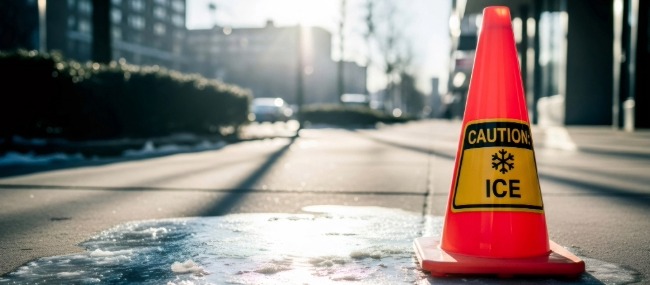
Reasonable care also means inspecting your property often enough to catch problems before someone gets hurt. A quick look in the morning is rarely enough, especially when temperatures jump above and below freezing throughout the day. When a hazard cannot be fixed immediately, placing clear, visible warnings helps reduce the risk. But warnings never replace the duty to correct the problem. A “Caution: Ice” sign does not excuse a property owner from clearing the ice.
Colorado law looks closely at whether the landowner acted promptly, paid attention to weather conditions, documented snow-removal efforts, and took the danger seriously. A landowner who ignores a known hazard or fails to check the property regularly risks liability when someone gets injured.
When someone slips and falls because of snow or ice, the PLA determines who is responsible for the medical bills, lost wages, pain and suffering, and long-term consequences. An injury can change a person’s life in a moment. A broken hip, torn ligaments, a concussion, or nerve damage can lead to months of treatment, missed work, and ongoing limitations. Under the PLA, the injured person can recover compensation when the landowner failed to take reasonable steps to prevent the danger.
Do Not Be the Sidewalk Villain
If you need motivation to shovel, consider the following extremely scientific categories of neighbors:
The Gold Star Shoveler – Clears their sidewalk before sunrise. Has warm cookies inside.
The “I’ll Do It Later” Guy – Spoiler: he will not do it later.
The One Perfect Shovel Line Person – They clear exactly one shovel-width path. Nothing more. Nothing less. A mystery to all.
The Snow-Blower Overachiever – Clears their sidewalk, your sidewalk, and possibly half the block.
The Sidewalk Villain – Never shovels. Creates an ice rink worthy of the Olympics. No one likes this person.
Do not be the Sidewalk Villain. Snow and ice does not form lawsuits, negligence does. A walkway left icy becomes a hazard waiting for a victim. Ignoring the snow and ice is not simply harmless, it is hazardous. Clearing snow in Colorado is only option if you do not mind being responsible for someone else’s medical bills.
The PLA does not judge personalities, but it does judge conduct. Stay off the villain list.
Call Bowman Law if You Were Injured in a Slip and Fall
If you have questions about snow and ice responsibilities, or if you slipped and fell on someone else’s property because they failed to maintain safe walkways, Bowman Law can help. Our team understands Colorado’s Premises Liability Act and how winter hazards impact your rights. Contact us today to discuss your situation and protect your ability to recover.
At Bowman Law, our personal injury lawyers understand how to combat aggressive corporate defense teams and powerful insurance carriers determined to limit payouts. We have the experience and resources to take on these challenges head-on. We have built a reputation by combining deep knowledge of skilled accident reconstruction and relentless advocacy for clients. At Bowman Law, we do not just handle cases — we build them to withstand the most aggressive defense strategies.
If you or a loved one has been injured in a winter accident in Colorado, contact a law firm with a proven record of success. Please send us a message or call us at 720-863-6904 to schedule a free case evaluation. Our Colorado truck accident lawyers will fight to protect your rights and deliver the justice you deserve. We serve clients across Colorado’s Front Range and beyond, including Denver, Colorado Springs, Boulder, Fort Collins, Westminster, Lakewood, and Aurora.
Jerry Bowman
Owner and Managing Attorney
Jerry Bowman, J.D., M.A., Owner and managing attorney of Bowman Law LLC, takes his responsibility to the legal profession seriously and dedicates his time and effort to providing quality and competent legal representation to clients in Denver and throughout all of Colorado. He holds an MA in Political Science from Wayne State University and earned his law degree in two and a half years from Michigan State University College of Law.
Yes. You may still have a slip-and-fall case in Colorado even if a “Wet Floor” sign was present. A warning sign is only one part of determining liability, and it does not automatically answer whether ...
Construction defects can be more than frustrating; they can cause property damage, financial loss, and even serious injury. Bowman Law represents homeowners and occupants recover compensation for construction-related damages under ...


 Return to All News & Resources